Surva Festival in Bulgaria

He who has not dressed himself does not know what I am talking about.
“Putting on the clothes, you purify yourself. Putting on the clothes you feel a very different emotion, you feel a power that comes from somewhere. I can’t explain how exactly it happens, but it’s very special. He who has not dressed himself does not know what I am talking about.”

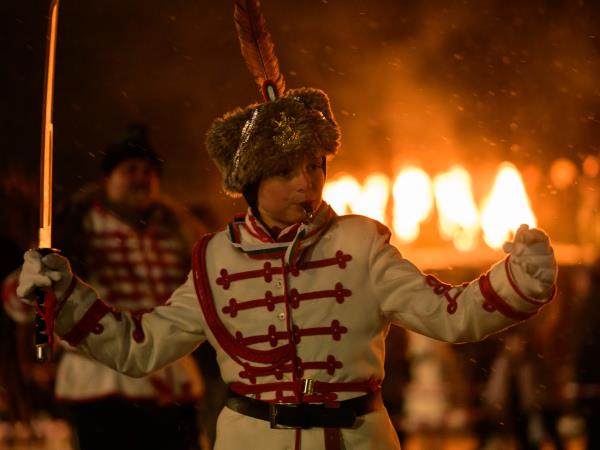
Georgi Ivanov is from the village of Kosharevo near Bulgaria’s border with Serbia. Every year he returns to his hometown to participate in its Surva festival, a masked celebration which occurs in communities across Bulgaria. Georgi, who makes masks for the festival, assembles friends at his house and dons the beautifully embroidered costume of a voivode (military leader). Georgi’s words were captured in a video by our partner Luka Esenko, who first went to witness the festivities in 2024. Luka so enjoyed the meeting that he now runs our annual Bulgaria photography tour to see the Surva Festival.

“I’ve very passionate about the Balkans,” says Luka, who is based in Ljubljana, Slovenia, “I always look for unique stories from this area. When I saw the festivals they had in Bulgaria I said to myself, ‘I have to photograph this, I have to make the story about this’.”

Joining the parade

Masked festivals like Surva are common all over Europe: from spring carnival celebrations like Venice’s glamorous masquerades, to mummers performances in England for Christmas, and the Nordics for St Catherine’s Day and St Stephen’s Day. Many masked festivals occur in winter and spring; like many other new year festivals, Surva began as a way to drive out evil spirits, and bring in good fortune for the year ahead. The festival’s parade goes into the long winter night – with bonfires, whistles and plenty of bells.

In Surva, participants are known as kukeri and join the parade as troupes – sometimes traveling from far away to perform. Kukeri dress in elaborate costumes – clothing made of red rags, heavy wooden masks over their heads, their legs strapped with clanging bells. Each performing group will have an accompanying musician. People dress as strange beasts, but also as familiar characters: priests and devils, bears and bear tamers, doctors and military men, and Bulgarian embroidery motifs (shevitsi) are on full display. In Georgi’s village, headdresses are made with so many poultry feathers that the coops are completely cleared out all year.

Like many traditional European festivals, Surva is a countrywide event, and its commerciality increases or lessens with the size of the town. Pernik in western Bulgaria has hosted an International Festival of Masquerade Games since the 1960s and is considered the central town for Surva celebrations. Here, the festival is covered by national press, over 12,000 performers take part and people come from a wide area to spectate. In smaller towns, there’s still a good show, but you might be the only international group there as witness.

Our top trip

Bulgaria photography tour, Surva festivals & traditions

Bulgaria photography tour, Surva festivals & traditions

Ancient traditions and festivals of Bulgaria

From 3750 7 days ex flights
Small group travel:
2028: 9 Jan

Contact Us

Responsible Travel, Travel Team

Call us for a chat about our vacations. We are happy to discuss your vacation and help in any way we can. No bots, queues or awful hold music.

Responsible Travel, Travel Team

Why visit the Surva Festival in Bulgaria?

I think in Bulgaria it’s the most authentic masked festival tradition I’ve seen. It’s not abused by tourists; it’s still very local. And I think it’s going to stay like that in these small villages, which have no infrastructure for mass tourism.
So why come to Bulgaria? For Luka, who has attended masked festivals in places from France to Italy, Croatia and Hungary, the appeal is clear: in Bulgaria this is a living tradition, unspoilt by mass tourism.

“It was so authentic – it wasn’t like a festival where people dress up for tourism. It’s really their way of life,” says Luka. “They want to keep up these traditions for the future, they involve their children and their whole family. Unlike other festivals where you’re fenced off from the stage and what’s going on, this is very different, you are part of it, you’re a participant.”

Everyone takes part in Surva, everyone is welcome. You’ll see both women and men performing as kukeri. “I’ve been impressed a few times,” says Luka. “Someone will be wearing this huge mask that must weigh 50 pounds or more – they take it off, and there’s a young girl inside. I’m like, ‘wow, how do you carry this and jump!’ – and those heavy bells they wear, too – and they jump all day in this outfit!”

Masking traditions bring the community together, encourage people to return to their hometowns and families, unite performers in their troupes, provide space for musicians, and preserve traditional crafting skills.

Photography trips

Whilst performers wait in the wings for their turn to perform, they interact with the crowd – priest characters might bless onlookers, devils might taunt them, people might just break character and wave at their friends. Best of all, they’re very happy to be photographed by onlookers. One of the challenges photographers have is finding willing subjects and here at Responsible Travel we’ve always maintained that photographing people who don’t want to be photographed is a big no-no.

During Bulgaria’s festival, this doesn’t seem to be a problem. “I really appreciated how open people are,” said Luka. “They enjoyed being photographed – they wanted to show their traditions, their culture.”

Luka, a highly experienced photographer, is well-versed in getting subjects to open up, and finding ways to break the ice. It’s far harder en-masse. “When you come with a group of photographers people are closed off and they shy away,” says Luka. “Additionally, some travelers aren’t experienced with photographing people and don’t know how to approach subjects. It’s really important to go to places where people are friendly and open and want to be photographed.”

Unlike many travelers, photographers can give back very easily. Luka’s groups travel with an interpreter who exchanges emails and WhatsApp numbers with the leaders of each troupe; that way, if a subject wants a photograph of themselves, they can get in touch and the group can email it on.

Visting small towns

“I’ve been to Pernik,” says Luka. “It’s really fun and great and you can photograph people off the stage when they’re preparing and dressing up – they’re very relaxed about it.” However, the town’s celebrations are famous and massive. “It’s photographically very frustrating as there’s always someone in the way.”

For the best experience, Luka thinks small towns are better, and he is able to provide groups with media passes, so they can get the best shots of the scenes they see. In smaller towns, it’s easier to see the little moments when the mask slips: “During one of the festivals in January it was snowing heavily and the makeup was melting on their faces,” says Luka, who remembers the small moments alongside the more bombastic ones.

Small towns require small groups so that they can comfortably be welcomed as guests in people’s homes, and go behind the scenes to the private areas where the costumes are made and stored. Every year, Luka’s group are invited back to Georgi’s town, and shown how the masks are made in his house.

After the nighttime procession of Surva comes a more intimate side to proceedings. For several days afterwards, the kukeri go around the houses of the community. Their aim is to visit every house and drive away evil spirits. The residents come out to greet them and feed them. There’s a lot of wine, rakia (fruit brandy), and stew. “Local people will offer you food and drinks as if you’re a part of the group,” says Luka. “You’re not treated like a tourist.”

By the end of the trip, dare Luka say it, a little photography fatigue sets in. “It’s so much good photography that it becomes too much – you cannot photograph everyone that wants to be photographed.”

After all, performers like Georgi are proud of what they do. Seeing these magnificent costumes shaking with bells and illuminated by the fires, it’s easy to understand why.

What do our vacations to photograph the Surva Festival entail?

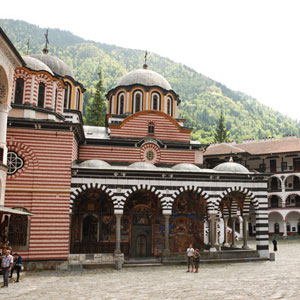
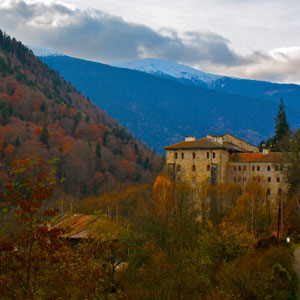
The Surva Festival takes place in January across Bulgaria, with a main hub being Pernik. With a guided group you can be taken to smaller towns to see less commercialised versions taking place. Our photography trips last around a week. As a photographer you will be given a special media pass in larger towns, providing you with exclusive access to the festivities. Trips may also include seeing some of Bulgaria’s must-visit sights such as attractions in Sofia, and the Rila Monastery. Along the way you’ll meet performers and you might be welcomed into their homes. You’ll stay in locally run hotels and patronise locally run restaurants throughout.
Written by Eloise Barker
Photo credits: [All images: Luka Esenko]