Best time to visit the Serengeti

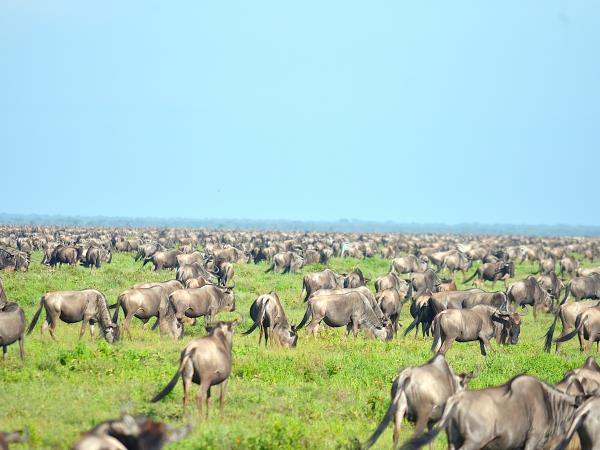
People have tried forever to predict the start of the Great Migration. But the animals' instincts will forever remain secret. No year is ever the same, which is why we love it.
The best time to visit the Serengeti for most people is when the Great Wildebeest Migration is in full flow, but actually you can see evidence of movement for many months, not just when the dramatic River Mara crossings are happening, which is June to September. During these months it is also extremely hot, pushing over the 30°C mark. Many people avoid the rainy season, March to early May, with another short one November to December. Although there is still great wildlife to be seen, at a fraction of the cost. However, January to February is green and gorgeous with young wildlife being introduced to the world.

Serengeti Weather Chart

 
MIN °C
MAX °C
RAIN (mm)
JAN
15
28
81
FEB
15
28
100
MAR
15
28
121
APR
16
26
147
MAY
15
25
68
JUN
13
25
23
JUL
13
25
9
AUG
14
26
19
SEP
14
27
34
OCT
15
28
51
NOV
15
27
100
DEC
15
27
97

Contact Us

Responsible Travel, Travel Team

Call us for a chat about our vacations. We are happy to discuss your vacation and help in any way we can. No bots, queues or awful hold music.

Responsible Travel, Travel Team

Serengeti travel advice

Amanda Marks: “The Great Migration moves constantly so you have it from December to March in the southern Serengeti – you can find the wildlife there quite easily. They tend to give birth at the beginning of the year, then move north and west, though they are more spread out so it’s not such a spectacle – but you can still find them. Then from July to October they are in Kenya, but they are also in the very north of the Serengeti, which is just as good a place to see the migration.”

Making the most of the experience

Andrew Appleyard, from our partner Exodus, on his love of the Serengeti: “It is one of those incredible things to see the huge migrations lines. When I led one of my last safaris down there we saw the Big Five within a few hours and so I asked the group what they wanted to do. They asked me “what would you do?” I said I’d park the vehicle up in the middle of the migration, turn the engine off and sit there for two or three hours and just watch it pass. And that would be my top tip. I’d also ban photography for an hour – get everyone to put their cameras down. Too many people just shoot Africa through a lens and come back with 7,000 images – but don’t actually just sit there and take it all in. So I make everyone put their cameras down and just sit there and watch it with their engines off.”

Family travel advice

Amanda Marks shares her advice for those traveling in the Serengeti and Tanzania with children: “I first took my children to Tanzania when my youngest was five. In the north it’s quite easy to have your own driver guide and your own vehicle; if you have that then you can do what you like. I travelled with children aged five, eight, 11 and 13 plus their parents – a group of 10. We had two vehicles and did what we wanted. You can do that in Kenya as well, but I think that Tanzania’s northern circuit has more places to stop, so it’s easier to break up the journey without traveling for miles and miles. If you have the right guide you’ll have a brilliant time. Ours had my youngest sat on his knee and he was driving the vehicle through the national park! It’s all about picking the right way to do a safari and choosing accommodation that has a pool. But if you choose the wrong places to stay and a guide not prepared for children, you won’t have a brilliant time, you won’t be able to let off steam at the end of the day and it can be quite boring if the children choose to tune out of the wildlife and are just sat in a car all day.”

Photography tips

Dereck and Beverly Joubert are internationally renowned filmmakers, conservationists and National Geographic Explorers-in-Residence. Here is their advice for taking better photographs on safari: "When people arrive with short lenses, the problem is that they push to get closer to the animals. But with digital cameras today, you don’t have to be as close as you think. You can always crop later on. The key is really to get natural behaviour by standing back a little bit and letting these things pan out. If you push too hard you will destroy the animals’ natural behaviour and your opportunities as a photographer."

TIPS FROM OUR TRAVELLERS

At Responsible Travel, we think the best people to advise our travelers are often... other travelers. They always return from our tours with packing tips, weather reports, ideas about what to do - and opinions about what not to.

We have selected some of the most useful Serengeti travel tips that our guests have provided over the years to help you make the very most of your vacation.
Our most memorable moments were our interactions with local people... We will forever hold in our hearts how warm and inviting everyone was.
– Teresa Vandenbosch
“Book stays in tented camps. These are much more exciting than lodges and extremely comfortable too... We loved the Serengeti most... and the way Albert, our guide, helped us discover it. Also, Kirirumu camp was fantastic” – Catherine Hofman

"If you go during the dry season be prepared for dust on a grand scale! Having said that what you are seeing and doing overrides any discomfort. Don’t forget your lip salve and hair conditioner as the air is very dry! You need to be fairly fit as the game drives involve long days over very bumpy roads ...make sure you always have tissues/loo paper with you as most toilet stops are al fresco” – Linda de Zilva

“The best tips I could give is: - Pack lightly (water is in short supply so bring things you can wear more than once) - Bring lots of US dollars (you can use US dollars everywhere - even in the tribal communities) - Buy on the local market (if you plan to donate to a school or community, buy the supplies locally to support the community rather than bringing them from home)” – Teresa Vandenbosch

“Aim to enjoy every part of the vacation, whether it is the flight in a prop plane and landing on an air strip with elephants and giraffes standing to on either side (or in the middle), or hundreds of hairy caterpillars in procession. Big or small, take it all in and enjoy watching and listening. The animals will be doing something different every time you see them and remember that it is a privilege to be in their environment. Don't worry about dressing up for travel or evening meals, and forget make-up and hair styling too. I would also recommend taking a travel washing line and biodegradable washing liquid and doing regular washes- the clothes dry quickly. And ladies, wear a sports bra”– Joanne Davenport

“Be prepared - it's a different world and if you want total relaxation and comfort, safaris aren't for you. However if you can put up with insect bites and a sore bottom then you will see some truly awesome sights. We think our vacation was well worth the money as we knew we were supporting local people and eco projects. That's what makes this vacation unique. Talk to your tour operator about how you can help the local people. The operator gave us great advice to bring pens and paper for the school kids, balloons as well and they loved that, we just wish we'd brought more” – Clare Hewitt
We found that the all day drive gave us the best opportunity for seeing the animals. Also we didn't expect the days to be so planned out but it worked really well...
– Tim Ferris
Written by Catherine Mack
Photo credits: [Page banner: Michiel Van Balen] [Top box: Snake3yes] [Migration: Wajahat Mahmood] [Masai: Sneha Ceci] [Sunset: ray rui]