Rail vacations in Spain

When people ask where you’re going in Spain, they usually expect a one- or two-word answer back: “Madrid” or “Costa Brava” – they don’t expect a sentence: “Barcelona, Madrid, Seville and Cordoba”.

Barcelona for breakfast, Madrid for midday, Seville for siesta: while it would never do to spend so little time in Madrid, thanks to Spain’s high-speed rail network it’s perfectly possible to breeze from city to city. Go by train on our Spain small group vacation to see more of the country in comfort.

Spain has an excellent rail network. The country has the second longest high-speed rail network in the world after China and the longest high-speed network in Europe, meaning you can whizz from Madrid to Seville at 200-300kph, and get to the Andalusian city in only two and a half hours.

There are nearly 4,000km of high-speed tracks laid out across the country. Most of the network radiates out of Madrid in four ‘corridors’. It’s made the train a no-brainer when weighing up between flights, driving and public transport for cross-country travel.

“I highly recommend it. It is comfortable and you can travel very nicely,” says Ellie, travel expert at Responsible Travel, who is Spanish and lives near Malaga. Before high-speed rail, business travelers used to fly between Barcelona and Madrid, but this has completely changed. “People prefer to go by train, now,” says Ellie. Flying isn’t recommended. “It takes forever, the airports are outside the city and you have to make your way out and in. It’s so much hassle compared to the train.”

Rail beats the car, too: “High speed has made a massive difference – to be in Madrid in three hours from Malaga – when you drive that’s six hours in the car in traffic! – Barcelona is the same.”

Rail travel is affordable and there are plenty of options – “The government now allows the private companies to run services on the lines so there’s more frequency and more affordable trains,” says Ellie.

Our escorted rail vacations take advantage of the network. Your schedule and tickets will all be arranged for you, and you’ll already have a seat reservation sorted (mandatory on most services). All that’s left to do is sit back and enjoy the ride.

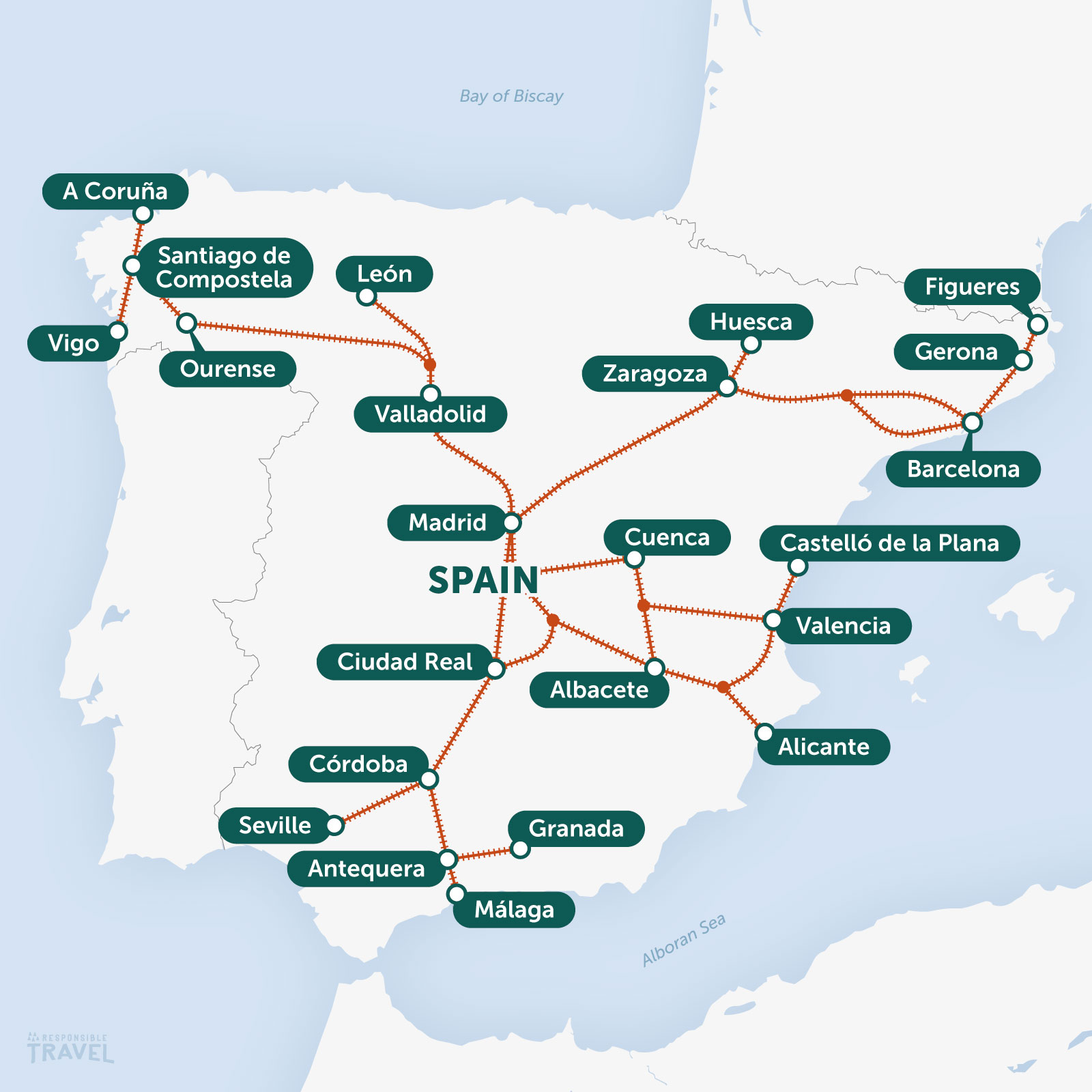
Spain’s high-speed rail network map

Spain high speed rail network map

It’s really well organised, works really well and is a great way to discover the country
– Ellie, from the Responsible Travel customer team.

Life on board Spain’s trains

Unlike airports, most train stations are conveniently located in city centers. Journeys can be a welcome distraction: “I liked how you saw the whole cross-section of big cities – center, suburbs, industry,” says Catherine, travel expert at Responsible Travel, who has travelled into Spain by train from the UK. “It was very hard to read my book because interesting things kept appearing in the window – a castle or a village or the mountains.”

Ellie often travels between Barcelona and Cordoba, and Malaga and Madrid. “They are very beautiful routes. You go through the countryside and you see how the landscape changes. It’s particularly spectacular when it has rained, because everything is so green.”

And speaking of green – just look at Atocha in Madrid. The 24-platform station is among the busiest railway stations in Europe, with over 100 million passengers a year. Yet it also has a tropical garden in its old trainshed – making it worth getting to the station early to take a look, and wind down somewhere beautiful before your journey.

Cruzcampo at cruising speed

“I loved that the bar car felt like an actual bar in the evening in Spain, everyone chatting and propped up on tables,” says Catherine. “Groups of friends kept walking up the carriage to the bar car and didn't come back.” Rubbing shoulders in the bar car is a feature on European trains, and especially true in Spain, adding a bit of festivity to your journey.

“That carriage is always full,” agrees Ellie, “People like to chat and socialise. You can tell when the people in the carriage are Spanish as there’ll be a lot of banter around.”

These are not trains put on for tourists, Ellie explains, which means they are a great way to immerse yourself in Spain’s diverse culture. “We take it all the time so by riding it you get a flavour of Spanish people and of Spain. Spain is becoming very multicultural. There are lots of people from South America living here now so you can hear so many accents.”

Contact Us

Responsible Travel, Travel Team

Call us for a chat about our vacations. We are happy to discuss your vacation and help in any way we can. No bots, queues or awful hold music.

Responsible Travel, Travel Team

Where to go in Spain by train on vacation

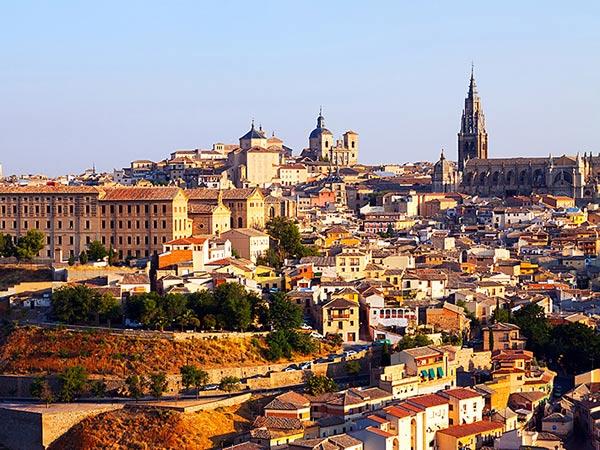
You can easily reach most major cities by train, and therefore many of Spain’s best tourist sights. Madrid’s amazing art museums, the Alcazar in Cordoba, Seville’s streets lined with orange trees, and Malaga’s Roman ruins. UNESCO-listed destinations like Toledo and Segovia are a direct train ride out of Madrid, and Montserrat is reachable directly by train from Barcelona.

A favorite route is to start in Barcelona, before heading to Madrid and then on to Cordoba and Seville. Malaga and Granada are both easy train rides away, and then you can head into Valencia to finish in the city of Valencia.

Heading for a single-center vacation? Many of our partners in Spain have detailed instructions for how to reach their local train station, and will offer a transfer service – sometimes that transfer is even free, to encourage travelers to choo-choo-choose the train.

Spain is connected to other countries in Europe, too – so you can reach the start of your vacation by train, arriving in Barcelona direct from Paris – this means you can travel to Spain from London, for instance, in a single day. You can also head on to Africa, taking a ferry from Tarifa to Tangier as part of our London to Morocco itinerary.

Spain also has a few quirky routes and trains, too: the tren de la fresa from Madrid travels through former strawberry fields and has a strawberry tasting on board. There are rack trains (cog railways) – including one up to Montserrat. Al Andalus – named after the Muslim-ruled Iberian Peninsula area – is a luxury tourist train that delves into Andalucia from Madrid and comes with lavish sleeper cars, a restaurant and four sumptuous lounges.

What to expect from our rail vacations in Spain?

You won’t travel on the train every day – and you’ll never be on the train for more than a few hours. The longest no-change train journey you can take in Spain is 14 hours and over 900km, from Barcelona to Vigo in Galicia. Most journeys on our vacations are less than three hours, such as Madrid to Barcelona, and Madrid and Seville. Our vacations prioritise time off the train in cities. For example, you’ll likely get on a train in the morning – giving you a day and a half at each new destination. Most of our tours are escorted small group tours with a guide. If you book an organised tour, all your trains and seats will be booked in advance. Seat reservations are mandatory on many services. Prepare for traveling time – that’s part of the fun – so sit back and look out the window, or crack open a drink at the bar. Pack light – as you’ll need to be able to lift your bag on and off trains, and put it in a luggage rack. We can help you arrange to get to your start point by train, too – for example getting to Barcelona or Madrid from France or elsewhere in Europe.
Written by Eloise Barker
Photo credits: [Page banner: Kabelleger / David Gubler] [Intro: Kabelleger] [: Matthew Black] [Barcelona: Pablo Nieto Abad]