

The Great Himalaya Trail

“We had snow leopards following us,” says Glyn. “Once, we woke up in the morning and found the prints of a leopard mother and cub on the ground – they’d been sniffing around our camp.”

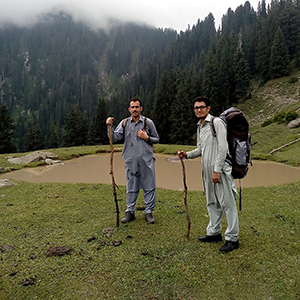
Glyn Harper travelled to Nepal in 2012 to do the trek of a lifetime – the Great Himalaya Trail with our trekking partner World Expeditions. He was expecting epic scenery on this five-month adventure across Nepal, but he wasn’t expecting this.

Five times, leopards followed the trekkers, but Glyn never saw them – probably for the best. “At the time, I thought it was very cool,” says Glyn. “Then later, I saw a snow leopard in a zoo and I realised how big they are…”

How many people have completed the Great Himalaya Trail?

There are very few people who can say they’ve been hunted by leopards, but then there are very few people in the world who have walked all the way across Nepal. An incomplete database compiled with the help of Robin Boustead, who conceptualised the trek, only has a record of just over 100 hikers completing the Great Himalaya Trail between 1994 and 2023. Compare that to the tens of thousands of hikers who clamber through the Everest region every year.

Introducing the Great Himalaya Trail

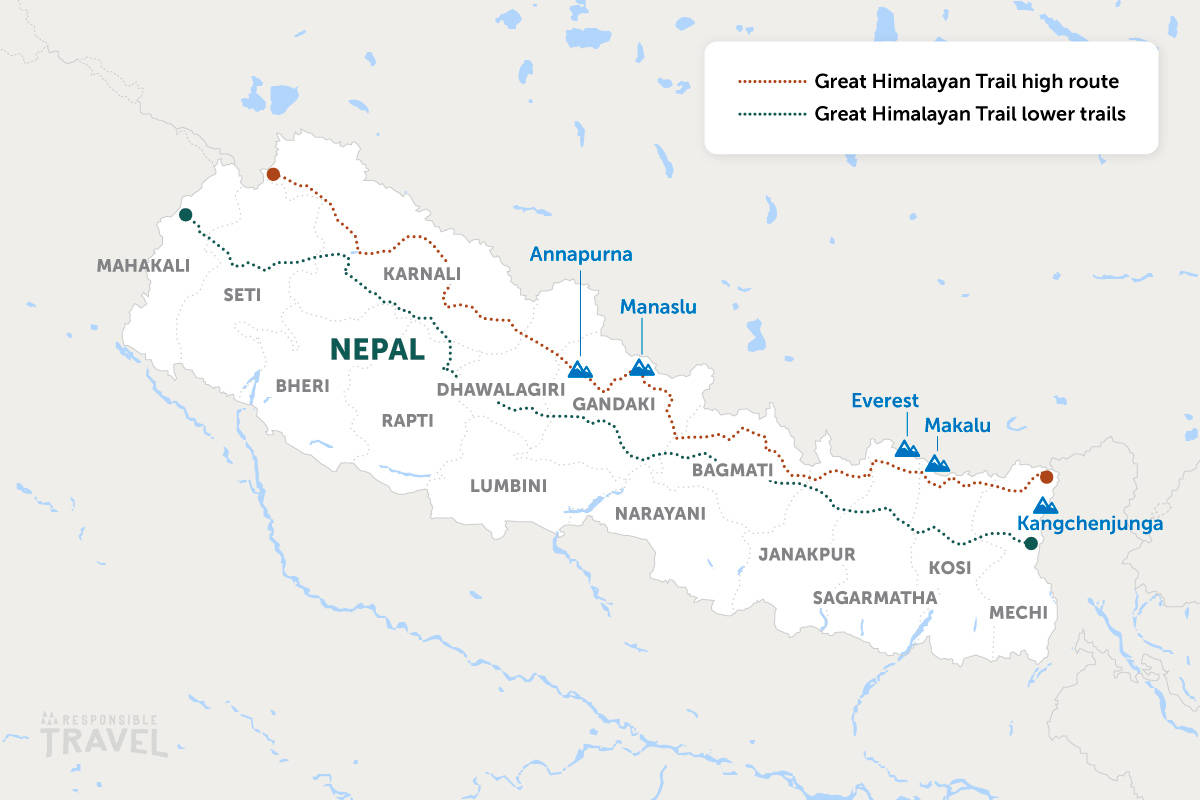
The Great Himalaya trail is a long-distance walking route across the Himalayas. Its Nepal section stretches from the far eastern edge of Nepal, in the Kanchenjunga trekking region, to the far west, the Humla region.

How long is the Great Himalaya Trail?

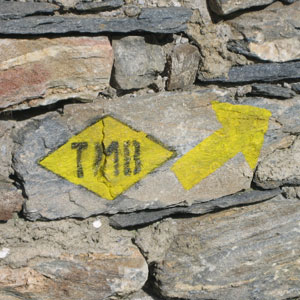
The section of the Great Himalaya Trail route in Nepal is 1,700km long. Whilst there's not always a marked official trail, the route that most expeditions takes crosses Nepal’s highest navigable passes. It runs close to all the country’s highest mountains and traverses its famous walking areas, including Annapurna, Manaslu and Everest. The literal high points include vertiginous passes like Sherpani Col (6,097m), Larkya La (5,106m) and Tilman Pass (5,320m).
There is also a low or 'cultural' route across Nepal. This doesn't reach the same high altitudes and can be completed in a shorter time.
The Great Himalayan Trail map: High and Low routes

How long does it take to hike the Great Himalaya Trail?

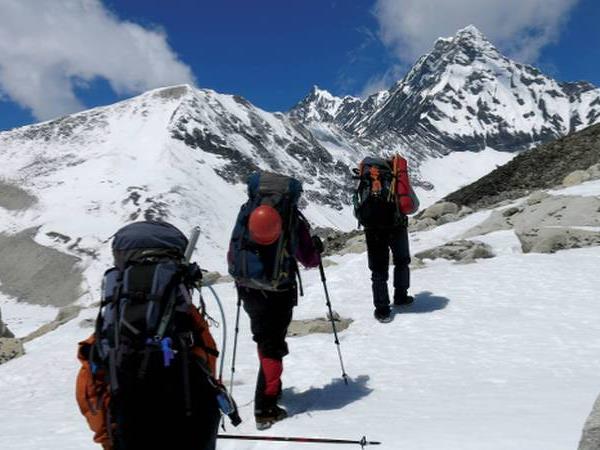
It takes around 150 days for an organised expedition to hike the Great Himalaya Trail. The trek starts in February, throwing trekkers into the remote east of Nepal, where they must break trail across snowy slopes. A few months later and the rhododendrons are in bloom; trekkers must cross rivers engorged by meltwater, by wobbling over rickety bridges – or by wading through.
It definitely was the biggest and the best adventure of my life. It’s on such a different scale from everything else it’s difficult to know what to do after that. I could never imagine doing anything like that again.

How hard is it to hike the Great Himalaya Trail?

It is a gruelling challenge. For one thing, high-altitude walking uses up an incredible amount of energy. “I had a mountain of food in front of me every night which I polished up,” Glyn says, yet he still lost just over 20 percent of his body weight over the months.

Organising a trek of this nature can be a logistical nightmare if you do it alone.

The trekking window is very specific for this five-month trek. The best time to do it is just at the end of winter, so that you’re finishing the trek as the monsoon starts.

“The way the trek unfolds, you get the really severe stuff at the beginning which is quite a shock,” says Glyn. “You start in the middle of winter going towards where no one else would go in February – Kanchenjunga.”

Trekking towards the world’s third highest mountain, the start of the trail goes through the lesser-visited east of Nepal, rising from farmland cardamom fields all the way to the foot of the massif’s Kanchenjunga glacier.

Our top trip

Great Himalaya Trail trek across Nepal

Great Himalaya Trail trek across Nepal

The ultimate adventure across Nepal on a 150 day trek

From US $35390 150 days ex flights
Small group travel:
2027: 10 Mar

Contact Us

Responsible Travel, Travel Team

Call us for a chat about our vacations. We are happy to discuss your vacation and help in any way we can. No bots, queues or awful hold music.

Responsible Travel, Travel Team

How to plan a trip on the GHT

Planning a trip like this without the support of a tour operator is the preserve of very experienced long-distance thru-hikers. It can mean multiple spreadsheets of inventory, distances, elevations and meal planning. Hikers need to carry enough food to carry them over to the next meeting point – and plan those refuelling points very carefully.

But there is another way. If you’ve got the money, then going with a very experienced specialist tour operator removes the tricky logistics, so you can focus on the journey itself. They can organise the food, the tents and the permits, and can show you the way along the trail – which is at times rough and very hard to follow.

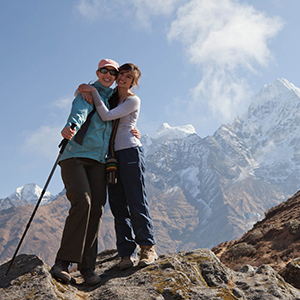
Glyn – a marketing consultant, and now an author – did the trek in his fifties by joining a tour. He was accompanied on the trail by his wife, Agnes, along with an American and an 18-year-old Australian. "It was very impressive," says Glyn, "I think he was 18 when he started – and 19 when he finished."

What is the route of the Great Himalaya Trail?

The Great Himalaya Trail puts the length of northern Nepal on a map. Just knowing that it can be traversed should inspire travelers to think outside the tried and tested trekking regions. “The beauty of the trail is that you encounter a huge variety of scenery,” says Glyn. “I think that’s the great strategic role the GHT can play in Nepalese trekking.”

Walking between areas heightens their differences, and their unique beauty. The Dolpo region, which sits in the rain shadow, is an extraordinary desert. It contrasts with the high snow-capped peaks of Makalu and Manaslu, and the protected forests around Rara Lake, in Rara National Park in the far west.

It’s difficult, of course, to steer travelers away from ‘bucket list’ places like Everest Base Camp, especially if they’re only planning to come to Nepal once in their lifetime. Nepal’s tourism is concentrated on Everest and Annapurna. After 50 days of trekking, passing no one but curious yaks and goats, it’s a shock to enter the Everest region.

“All of a sudden there were hordes of tourists,” says Glyn. “We had to follow the rucksack in front of us.”

Not everyone who does this trek does it in one go. Some solo trekkers who hike this track have been known to come off the trail for weeks at a time – getting off at a village, bussing to a town and then on to Kathmandu to resupply and rest – before taking on the next section. Glyn and Agnes had to leave the trail after Agnes became ill crossing Sherpani Col. They rejoined the trail at a later point, and Glyn returned the following year to complete the section they had missed.

Trekkers joined the group for particular legs – like the dramatic, snowy trek in the Kanchenjunga massif in the far east in February, or for Langtang and the Tilman Pass, replenishing the trek not just with new supplies, but also bringing new porters and new conversation.
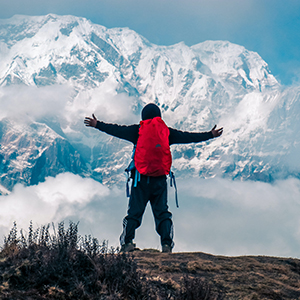
It was very strange to see the scale of it – I remember right at the beginning we were looking at the mountains, then the clouds cleared and there were 3,000 metres more mountain behind. I came back to Scotland after I came back from my trek – and I thought oh my God, all the mountains have shrunk!

It takes a village

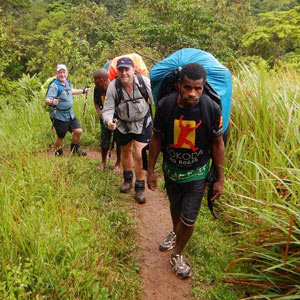
People are an important part of any journey – their conspicuous absence, meetings, farewells, reunions. On a supported expedition, trips start with porters and guides – at any one time on the trek there were between eight and 20 supporting Glyn’s group. In the west, as the landscape changed and became lower, mules carried the bags.

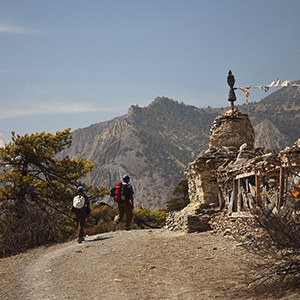
There are villages on this trek where a trekking caravan arriving is something of an event – there won’t have been another visitor in weeks.

Glyn, who learnt a bit of Nepali, was able to share his thanks with the porters when they finished their leg of the trek. It is telling too that, when asked of the many photographs he took, which was his favorite, Glyn plumps for those with people in them, and villages – which became more frequent in the less remote west.

Later in the trek, the trail passes into the warm forests and the temperature climbs – to 30°C or more. “There was some scat from a Bengal tiger on the path,” Glyn says.

From snow leopards to tigers – or out of the frying pan, into the fire – there aren’t many treks where you cross between the territories of the rarest big cats.

Ending on a high

This is an encyclopaedic encounter with a country. And when it ends, its influence lives on.

“I did a major career change after the GHT,” says Glyn. “I’m now an author.”

“I think doing the GHT affected that,” says Glyn. “When you set off and you look at a map of Nepal and you realise you’ve done 1cm along the map and there’s all the rest of Nepal to go – that’s a bit like writing a novel. You write your first word and you have another 80k to do… There were a lot of similarities to the GHT – the psychology of it.”

From snow leopards, glacier crevasses and unbroken snow slopes to a green, yellow and white-iced cake baked to celebrate finishing at the Tibetan border. This trek might be extraordinary in its variety, but you don’t need to be extraordinary to do it.

In Glyn’s parting words: “If you’re thinking of doing all or part, don’t overthink it – it’s very easy to convince yourself that you can’t do something like this. But, actually, the people who do it are not hardcore mountaineers or super athletes; they just want to have an adventure of a lifetime.”

Practicalities

Most Great Himalaya Trail treks start in February, finishing five months later in July. This trek is difficult and requires excellent fitness and stamina. Basic mountaineering skills are needed – and experience using an ice axe and crampons is preferred, though not compulsory. Walkers should be prepared for high-altitude trekking and prior experience of multi-day high-altitude hikes is must. Because of the altitude, walkers must be prepared to acclimatise, and for slower going the higher they go. There are dozens of mountain passes to cross on this trek. The maximum altitude is a dizzying 6,190m. You’ll likely be camping for most of this trip in non-permanent camps picked for their scenic locations. You will carry a day pack with essentials, which might be an ice axe, crampons and harness one week, and sun cream, lip balm and a hat the next – or extra shoes for crossing rivers. Porters – and later in the trek, when possible, porters using pack animals – carry other equipment, tents and food. They’ll prepare food, so you will get hot, if basic, meals. Porter welfare is vital, and booking with a responsible tour operator means that the people who trek with you are treated fairly, given the proper equipment and insurance, and paid a good working wage. All tourists to Nepal need a visa, and this trip requires you to also apply for a visa extension when you are in Nepal. The tour operator will help you with this. Tourists will also need insurance; make sure that yours covers you up to the maximum elevation of the walk.
Written by Eloise Barker
Photo credits: [Page banner: © Glyn Harper] [Intro: © Glyn Harper] [How long is the Great Himalaya Trail?: © Glyn Harper] [Glyn Harper: © Glyn Harper] [What is the route of the Great Himalaya Trail?: © Glyn Harper] [It takes a village: © Glyn Harper]