Visiting the churches & monasteries of Moldova
There are approximately 1,500 Orthodox churches and 50 monasteries in Moldova, some of them architecturally significant or housing well-preserved ancient frescoes. This is one of the most religious countries in Europe, where around 90 percent of the population follow Eastern Orthodox Christianity.
During the 20th century when Moldova was part of the Soviet Union, organised religion was strongly discouraged by the authorities and many of these structures were damaged, destroyed or repurposed. Since the 1990s they have been undergoing a process of restoration, which our vacations help encourage and fund through the payment of entrance fees.
Churches and monasteries are everywhere in Moldova. Over 90 percent of Moldovans follow Eastern Orthodox Christianity, though there is a schism due to a dispute rooted in the region's complex 19th and 20th-century history. The vast majority are members of the Moldovan Orthodox Church, which is subordinate to the Moscow Patriarchate, allowing Russia to exert considerable influence in Moldovan society. The rest follow the Romanian Orthodox Church. Though separate, the two churches have a lot in common structurally, culturally and theologically.
When I spoke to Emma Holmes from our partner Undiscovered Destinations about vacations visiting Moldova’s churches and monasteries, she was just back from a trip around the country. “The buildings are really well-kept and feel very new inside because since 1992 everything has been painstakingly restored, so the colours are vibrant. The interiors are ornate, a lot of gold, very shiny. It’s an interesting mix of the historic and the modern. They have beautiful and distinctive shapes, too. Some of the domes are gold leaf, some of them are painted different colours. They stand out of the landscape wherever you are.”
On our Moldova vacations you will usually be accompanied by a local guide when you visit churches and monasteries. Since many are still in daily use by the faithful, your guide will help you to understand what is expected when exploring these buildings. For example, it is considered respectful for women to cover their heads, and men to remove their hats, while inside.
During the 20th century when Moldova was part of the Soviet Union, organised religion was strongly discouraged by the authorities and many of these structures were damaged, destroyed or repurposed. Since the 1990s they have been undergoing a process of restoration, which our vacations help encourage and fund through the payment of entrance fees.
Churches and monasteries are everywhere in Moldova. Over 90 percent of Moldovans follow Eastern Orthodox Christianity, though there is a schism due to a dispute rooted in the region's complex 19th and 20th-century history. The vast majority are members of the Moldovan Orthodox Church, which is subordinate to the Moscow Patriarchate, allowing Russia to exert considerable influence in Moldovan society. The rest follow the Romanian Orthodox Church. Though separate, the two churches have a lot in common structurally, culturally and theologically.
When I spoke to Emma Holmes from our partner Undiscovered Destinations about vacations visiting Moldova’s churches and monasteries, she was just back from a trip around the country. “The buildings are really well-kept and feel very new inside because since 1992 everything has been painstakingly restored, so the colours are vibrant. The interiors are ornate, a lot of gold, very shiny. It’s an interesting mix of the historic and the modern. They have beautiful and distinctive shapes, too. Some of the domes are gold leaf, some of them are painted different colours. They stand out of the landscape wherever you are.”
On our Moldova vacations you will usually be accompanied by a local guide when you visit churches and monasteries. Since many are still in daily use by the faithful, your guide will help you to understand what is expected when exploring these buildings. For example, it is considered respectful for women to cover their heads, and men to remove their hats, while inside.

Religion in Moldova
Moldova’s religious buildings often sit alongside imposing and bland structures that were built during the days of the atheist Soviet Union. Moldova was a Soviet socialist republic between 1940 and 1991 and during this period organised religion was heavily discouraged. Many priests were arrested, deported or murdered, their churches and monasteries forced to close and either destroyed, damaged or repurposed, their congregations split up. Religious beliefs and instruction survived through parents and priests passing them on informally.The Church remains enormously influential in Moldovan society. Many people put greater faith in religious institutions than political ones, though the Moldovan Orthodox Church’s links to Russia have come under increasing scrutiny since the invasion of Ukraine, Moldova’s neighbour to the north. Because of this, some priests and parishioners are reportedly switching their allegiance to the Metropolis of Bessarabia.

Moldovan graveyards are arranged with tables and chairs so that families can gather to share meals with their deceased relatives![]()

The two Churches follow different calendars – the Romanian Orthodox Church generally follows the Revised Julian calendar, and the Russian Orthodox Church uses the traditional, unrevised Julian calendar. In Moldova, local practice can vary, so people celebrate important dates such as Christmas on different days of the year.
On many of those occasions, such as ‘Easter for the Dead’ (a week after Orthodox Easter, which both Churches usually celebrate together), families traditionally gather in cemeteries around Moldova for what are known as pomana. People bring bread, wine, meat and vegetable dishes, sometimes bottles of homemade spirits, to share around their relatives’ gravesides, sometimes also leaving behind gifts such as sweets or clothing for the deceased to use in the afterlife. If you visit a cemetery in Moldova, you’ll see there are benches and tables around the tombstones for this tradition, which has pre-Christian pagan origins, helping to ease the grieving process.
On many of those occasions, such as ‘Easter for the Dead’ (a week after Orthodox Easter, which both Churches usually celebrate together), families traditionally gather in cemeteries around Moldova for what are known as pomana. People bring bread, wine, meat and vegetable dishes, sometimes bottles of homemade spirits, to share around their relatives’ gravesides, sometimes also leaving behind gifts such as sweets or clothing for the deceased to use in the afterlife. If you visit a cemetery in Moldova, you’ll see there are benches and tables around the tombstones for this tradition, which has pre-Christian pagan origins, helping to ease the grieving process.
Moldova vacation
A cultural tour through the fascinating country of Moldova
From
£1395
7 days
ex flights
Moldova food and wine tour, tailor made
Blend great food, wine and history in Moldova
From
£1795
6 days
ex flights
Moldova cultural vacation
Traditions & culture of a hidden part of Europe
From
£1199 to £1285
7 days
ex flights


Contact Us
Call us for a chat about our vacations. We are happy to discuss your vacation and help in any way we can. No bots, queues or awful hold music.

1-866-821-6866
Call toll free
Calling from outside the USA

Notable churches & monasteries in Moldova
Some of the most significant churches and monasteries in Moldova include the Nativity Cathedral in Chisinau, the ancient hermitage of Orheiul Vechi and the Assumption of Virgin Mary Church, known for its well-preserved frescoes.
As well as being one of the most religious countries in Europe, Moldova is among the least affluent. Restoring its places of worship after years of neglect is a process that requires time and money. Where entrance fees are requested, our vacations will always pay them, and where they are not, if you see a donation box we recommend putting a little cash inside.
As well as being one of the most religious countries in Europe, Moldova is among the least affluent. Restoring its places of worship after years of neglect is a process that requires time and money. Where entrance fees are requested, our vacations will always pay them, and where they are not, if you see a donation box we recommend putting a little cash inside.
Orheiul Vechi
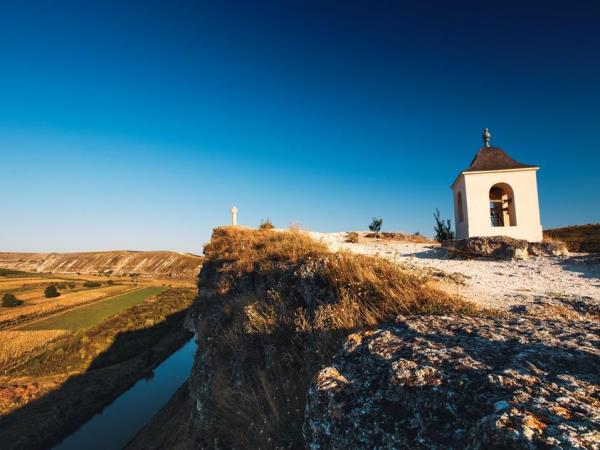
Sometimes known as ‘the church of the caves,’ Orheiul Vechi is among the most well-known tourism destinations in Moldova. This 13th-century monastic complex is carved into a limestone bluff overlooking the Raut River, 50km north of Chisinau. The caves are inhabited by a hermit who has devoted his life to religion, his needs looked after by the monks who live in the monastery above ground.
“You go down a set of stairs into the cave where the chapel is,” says Emma, “and then on the right is what I presume is the altar, and the monk stands to the left as you go in. He's got his plinth and that's where his verses are. He's got a tiny little bed to the side where he sleeps. And then you walk through a doorway and look out onto this incredible vista of the river and the fields beyond it. He might be the last of his kind as none of the younger monks want that hermit life. They want freedom to go elsewhere.”
“You go down a set of stairs into the cave where the chapel is,” says Emma, “and then on the right is what I presume is the altar, and the monk stands to the left as you go in. He's got his plinth and that's where his verses are. He's got a tiny little bed to the side where he sleeps. And then you walk through a doorway and look out onto this incredible vista of the river and the fields beyond it. He might be the last of his kind as none of the younger monks want that hermit life. They want freedom to go elsewhere.”
Curchi Monastery
Curchi Monastery, originally built from wood by two brothers in 1773 and then rebuilt in the baroque style, is one of Moldova’s most handsome religious buildings. The main church, painted bright red, with three domes, dominates the surroundings. It served as a hospital for psychiatric patients until the collapse of the Soviet Union, after which it was restored with an extensive renovation project.
Assumption of Virgin Mary Church, Causeni
This mid-17th-century church is known for its remarkably well-preserved frescoes which are emblematic of Moldova’s deep religious heritage. It served as a warehouse, and then a factory, during the Soviet period, which led to the frescoes being damaged. They have been restored at considerable expense, and this is one of the few religious buildings in the country where entrance fees are payable – it is not a working church.
Interestingly, the church is built into the ground, so that it looks smaller from the outside than it actually is. The reason for this is that it was constructed during the Ottoman era, when churches were not allowed to stand taller than mosques.
Interestingly, the church is built into the ground, so that it looks smaller from the outside than it actually is. The reason for this is that it was constructed during the Ottoman era, when churches were not allowed to stand taller than mosques.
Capriana Monastery, Codril Forest
Situated in a picturesque wooded hollow 40km outside of the capital, Chisinau, this is one of the oldest religious structures in Moldova, dating back to the early 15th century. Legend has it that an early ruler, Stefan the Great, took pity on a roe deer that he was hunting here. Shortly after, his daughter Ana was born, and in tribute Stefan founded the monastery combining her name with capra (roe deer). The monastery was used as a sanatorium for tuberculosis from the 1960s until it reopened in 1989.
Martha & Maria Convent, Hagimus
Or to give it its full name, the Holy Myrrh-Bearing Women Martha and Mary Convent. The convent was founded in 1997, in a forested village called Hagimus. There’s a spring where the faithful sometimes take a dip, and it’s said that praying while doing so can help wishes come true.
Nativity Cathedral, Chisinau
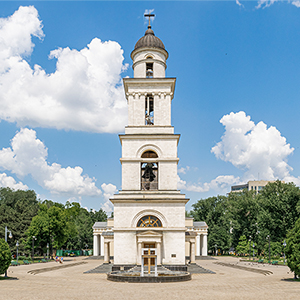
Built in 1830, the Nativity Cathedral is the main cathedral of the Moldovan Orthodox Church. A handsome building with six Doric columns at its entrance, during the Soviet era it was repurposed as an exhibition hall. The bell tower was destroyed in 1962, supposedly to prevent it from being used by assassins targeting government officials! It was rebuilt in the 1990s.
Horodiste Cave Monastery, Tipova
The Horodiste Cave Monastery near the village of Tipova is a fascinating architectural achievement. Carved into the cliffs, 200m above the Dniester River, its earliest incarnation dates as far back as the 11th century.
Condrita Monastery, Codril Forest
Originally part of the nearby Capriana Monastery but now separate, the Condrita Monastery is one of the loveliest spots in Moldova for a moment of quiet reflection. This peaceful monastic site with its stone churches and restored frescoes, founded in 1783, sits at the edge of the Codril Forest.
Japca Monastery, near Camenca
This riverside monastery in northeast Moldova was the only one that continued to function through the Soviet period. It takes a very conservative approach – there’s no electricity, the resident nuns follow a strict vegetarian diet, and all services are performed in Old Church Slavonic. There are holy waters here said to have healing properties.
Candle of Gratitude, Soroca
Erected on a clifftop overlooking the Dniester River, near the border with Ukraine, the Candle of Gratitude is neither church nor monastery, but a symbol of gratitude for Moldovan culture, faith and spirituality.
More Moldova articles
Learn when to go to Moldova, as well as some of the best things to do while there.