Yoga and trekking vacation in Nepal
Price
US $1850ToUS $1900 including domestic flights only
More info
Price is for min 2 pax min;
The best time to visit is during warm months: October-December; March-June.
Suitable for beginners and intermediate level.
Contact us for customization or your own dates.
Offers
$50 off per person on October–November departures. Don't miss out—secure your seat by contacting us today.

Description of Yoga and trekking vacation in Nepal
Price information
US $1850ToUS $1900 including domestic flights only
Price is for min 2 pax min;
The best time to visit is during warm months: October-December; March-June.
Suitable for beginners and intermediate level.
Contact us for customization or your own dates.
Check dates
2026: 27 Oct
Travel guides
Discover whether a walk in the Himalayas is for you with our guide to the ups and downs.
Be part of a pack on your next outing. These small group walks promise fun and friendship on the trail.
Reviews
1 Reviews of Yoga and trekking vacation in Nepal
3 out of 5 stars
Reviewed on 10 Nov 2025 by CL MILLER
1. What was the most memorable or exciting part of your vacation?
The land and the people.
2. What tips would you give other travelers booking this vacation?
Prepare for everything in your minimalist packing.
3. Did you feel that your vacation benefited local people, reduced environmental impacts or supported conservation?
Yes
4. Finally, how would you rate your vacation overall?
The guide was just ok and some of the accommodations were very sub-par.
Read the operator's response here:
Thank you very much, Cynthia, for sharing your feedback and for joining our yoga trek in the Everest region. We’re really happy to hear you enjoyed the stunning landscapes and the warmth of the local people.
We’re sorry to read that some of the accommodations and guiding aspects didn’t fully meet your expectations. The teahouses along the trail are locally run and are quite simple, but they provide a unique way to directly support those, who live in the remote parts of the Himalayas, which is an essential part of how we operate as a responsible travel company. We use locally run accommodation.
We appreciate your comments and will share them with our team of guides to ensure future trips maintain both authenticity and comfort wherever possible. We will try to choose more carefully better options for our next trips. Thank you again for traveling with us and helping to support the people of Nepal.
Warmly,
Lesia
We’re sorry to read that some of the accommodations and guiding aspects didn’t fully meet your expectations. The teahouses along the trail are locally run and are quite simple, but they provide a unique way to directly support those, who live in the remote parts of the Himalayas, which is an essential part of how we operate as a responsible travel company. We use locally run accommodation.
We appreciate your comments and will share them with our team of guides to ensure future trips maintain both authenticity and comfort wherever possible. We will try to choose more carefully better options for our next trips. Thank you again for traveling with us and helping to support the people of Nepal.
Warmly,
Lesia
Responsible Travel
As the pioneers of responsible tourism, we've screened this (and every) vacation so that you can travel knowing we've worked to maximise the benefits of your vacation to local people and places, and minimise any negative impacts.
Planet
Responsible trekking on the Everest Yoga TrekThe Khumbu is one of the most ecologically sensitive trekking corridors in Nepal. Sagarmatha National Park covers 1,148 sq km of protected Himalayan habitat, and the pressure from roughly 50,000 annual trekkers is visible in ways that weren't true a generation ago. We ask everyone on this trek to treat the mountains with the same care they'd give their own home.
Leave no trace. There are designated waste collection points along the trail and at each overnight stop. Use them. We do not permit littering at any point on the route, and this applies equally to porters, guides, and guests. If you see waste on the trail, pick it up.
Water. The Khumbu has reliable spring water sources throughout the route, and our guides know exactly where to refill. Carry a reusable bottle and refill at designated clean water points instead of buying plastic mineral water at each tea house. It's cheaper and considerably less damaging to the environment at altitude, where plastic waste removal is slow and expensive.
Charging devices. Solar panels are the only electricity source at altitude. Tea houses charge a small fee per device; budget for this rather than expecting free charging. We keep group device use reasonable to avoid overloading small systems.
Wildlife. Bird diversity in the Khumbu is high — over 200 species have been recorded in Sagarmatha National Park, including the Himalayan monal (Nepal's national bird) and several high-altitude raptors. Watch quietly. Don't whistle, throw stones, or approach nesting sites. Musk deer live at these elevations; if you encounter one, stand still and let it move off on its own. Do not feed any wild animals or stray dogs.
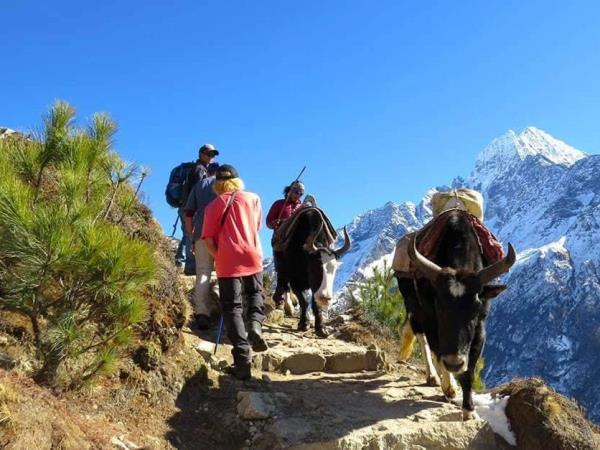
Yaks. The trail shares space with yak trains carrying supplies between villages. Yaks are generally calm but weigh up to 300 kg and will defend themselves if they feel cornered. When a yak train approaches, move to the uphill side of the trail, stay close to the rock face or embankment, and wait for the animals to pass. Do not stand on the outer edge of the path. Do not attempt to ride yaks or take close-range photographs that require approaching them directly.
Wild buffalo are occasionally encountered at higher elevations. Keep your distance and do not approach or make sudden movements toward them.
Food. All meals on this trek are vegetarian or vegan, prepared from organic produce grown by local farmers in the Khumbu and surrounding valleys. The menu changes seasonally based on what's available. There are no meat options on this itinerary.
Accommodation. Every tea house on this route is chosen for its environmental practices: solar power, electric or gas stoves where available, waste separation, and locally sourced food. We do not book accommodation that uses wood-burning stoves inside sleeping areas or that disposes of waste unsorted.
People
Sherpa culture and supporting local communitiesSherpa is an ethnic group, not a job title. The word is frequently misused as a synonym for porter, but Sherpas are a distinct Tibeto-Burman people who migrated to the Khumbu region from eastern Tibet around 500 years ago. Their physiological adaptation to altitude — documented in studies by University of Cambridge researchers — includes genetic variants that increase oxygen efficiency in thin air, giving them a measurable advantage above 3,500 m that lowland-born people do not have regardless of fitness level. This is the region they come from. Every guide, tea house owner, porter, and monastery caretaker you meet on this trek is part of a community that has lived and worked in these mountains for generations.
Your lead guide is Sherpa, speaks Nepali and the local Sherpa language, and knows the cultural protocols of each village on the route. Not every person you meet will speak English or be familiar with Western customs — that goes both ways, and those conversations are usually the most interesting ones. If communication is difficult, your guide translates. Talk to people. Ask questions. The interaction is part of what you came for.
Where your money goes. In the Khumbu, the local economy runs almost entirely on trekking. Tea houses, small trail-side shops, and craft sellers have no other consistent income source. When you buy a meal, a snack, or a hand-made item directly from a local vendor, that money goes to the family running the business — not to a distributor or booking platform.
On bargaining: negotiating prices is normal in Nepali market culture, but the Khumbu trail is not a tourist market. A trekking pole or a buff sold for $1 at cost covers almost nothing for the seller after materials. If you're uncertain whether a price is fair, ask your guide before negotiating down. The margin on most trail-side goods is already thin.
Stay in the tea houses we've selected. Eat the food they prepare. Buy what you need from the shops along the route. This is the most direct way to ensure the communities hosting this trek are supported by it.
Popular similar vacations
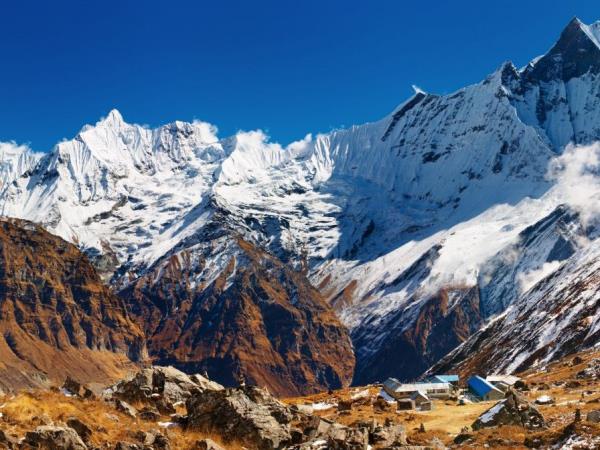
Annapurna Base Camp trekking vacations
From US $1135 - US $1550 8 days including domestic flights only
Most popular, legendary and classical trek in the world
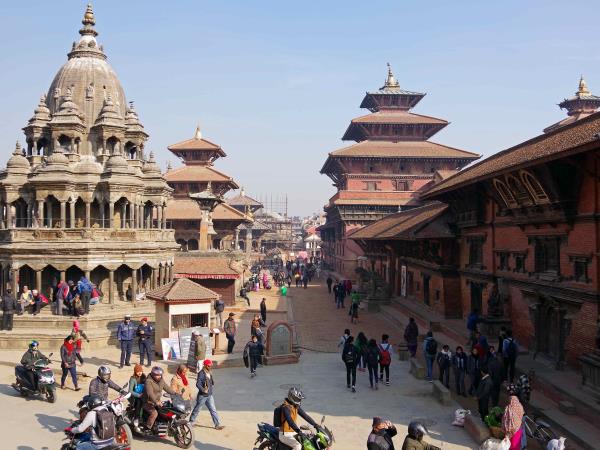
Nepal, Bhutan and Tibet Tour
From US $3600 21 days excluding flights
A cultural extravaganza in landlocked South Asian countries
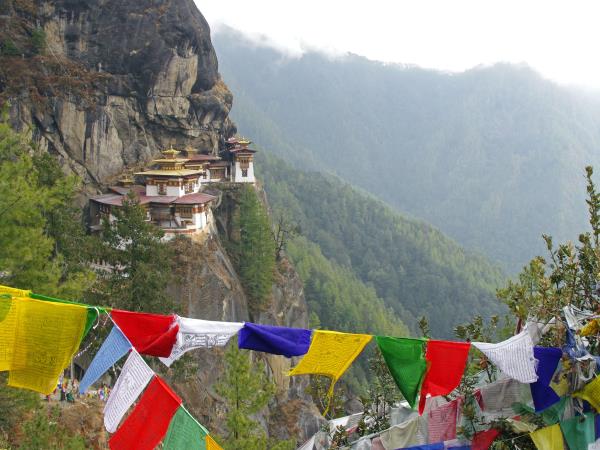
Nepal and Bhutan express tour
From US $2100 7 days excluding flights
Become one with culture and nature in Bhutan and Nepal tour