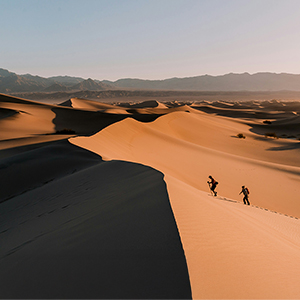
With singing dunes, shimmering salt flats, weathered peaks, steep canyons and twisted vegetation, California’s deserts have a strikingly sculptural appeal. Photographers, artists and stargazers come here to enjoy the clear light and impressive landscapes, whose colours range from palest bone to ochre, russet and crimson. Here and there are natural oddities such as the Trona Pinnacles, pointed tufa rocks which look deliberately planted. The Deserts region has much to offer active adventurers, too: there are rock formations to test climbers, canyons to thrill mountain bikers and, in winter, snow-capped peaks to challenge hikers.
Situated in the rain shadow of the mighty Sierra Nevada, this is a devastatingly arid region. It’s home to the place which holds the world record for the hottest ever daytime temperature, Furnace Creek in Death Valley, California’s largest national park. This is the unforgiving heart of the Mojave Desert, a vast area of almost 50,000 square miles which also contains the Mojave National Preserve and Joshua Tree National Park.
South of the Mojave is the Colorado Desert, a huge, sandy region which includes the heavily irrigated Coachella and Imperial Valleys, the Anza-Borrego Desert State Park and the eerie, mirror-like Salton Sea, a shallow salt lake situated right on the San Andreas Fault.
To enjoy the deserts’ kinder side, visit between October and April. It’s particularly beautiful in spring. Between February and April, wildflowers of all colours burst into bloom, carpeting the desert floor, and in February and March, the distinctive Joshua Trees grace the landscape with their large white flowers.
The most popular base is Palm Springs, a city that’s a favorite retreat of the rich and famous, with manicured golf courses and a character all its own, but there are also places to stay in Twenty Nine Palms and Furnace Creek.