Cycling in Namibia travel guide
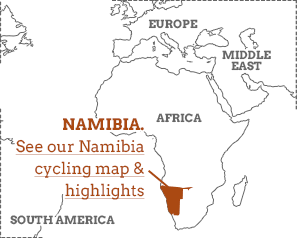
Vacations don’t sound more intrepid than this. Empty, epic Namibia is dominated by two deserts, and has the highest sand dunes in the world. Tell people you’re planning to cycle here and their first question might be – can you cycle up a sand dune? In reality, cycling in Namibia is as much about stopping and sightseeing (and giving your buttocks a break) as it is about eating up the vast landscape under two wheels.

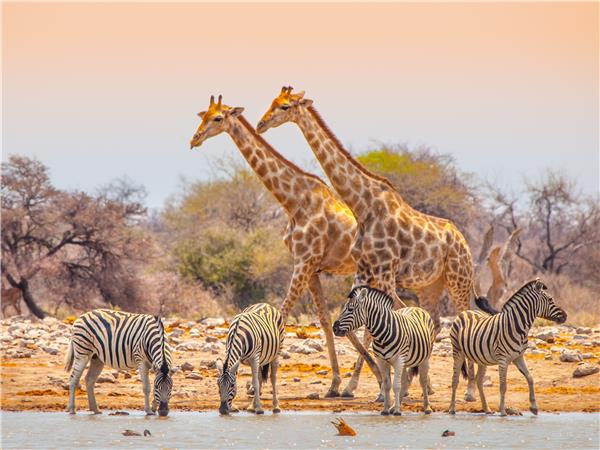
Get used to braking at zebra crossings. By which we mean: stopping to let herds of Hartmann’s mountain zebras run across the road.![]()

Namibia’s burnt landscape looks hardy, but is actually very fragile. In 2019, it experienced its worst drought in seven years, and declared its second state of emergency in three years. Camping as you bike saves vital water, and opting for two wheels allows you to cover great distances with little noise pollution. Cycling is great for wildlife spotting, and makes you feel like you’ve truly earned each view. With local guides on hand to help you tell a gemsbok from a springbok, and Dune 40 from Dune 45, don’t just tick Sossusvlei off your bucket list, find out what makes Sossusvlei tick.

Go cycling in Namibia if...
Don’t go cycling in Namibia if...
Our top trip
Namibia biking vacation
Wide open spaces, endless skies & sand dunes
From
US $4915 to US $5410
12 days
ex flights
Small group travel:
2026: 27 Sep, 11 Oct
2027: 9 May, 23 Jun, 18 Jul, 15 Aug, 26 Sep, 3 Oct, 14 Nov
2026: 27 Sep, 11 Oct
2027: 9 May, 23 Jun, 18 Jul, 15 Aug, 26 Sep, 3 Oct, 14 Nov
Best time to go
Group cycling trips run in March, May, October and December – the southern summer has its hottest temperatures in November, December and January, so be prepared to set out early in the morning to beat the heat. The rainy season means there’s higher rainfall from January to March, but it’s rarely torrential and the landscape turns lush and green. The best time for game viewing in Etosha National Park is in the drier months (the southern winter, running from April to November) , when wildlife converges on the water holes.
Responsible travel
In the last five years or so, tourism to Namibia has seen a big increase, but the country still retains its absorbing emptiness. Namibia has adapted to tourism well, and a lot of money goes back into conservation projects. Park entrance fees are reinvested in the landscape by the Ministry of Environmental and Tourism, the whole coastline is protected through national parks, as is 19% of the country.
However, water is scarce. In 2019, Namibia experienced terrible drought – the worst in seven years, which is killing wildlife and putting 500,000 people at risk. Many of the lodges that you’ll visit use solar panels, collect rainwater and reuse shower water as ‘grey water’ for cleaning floors. Be very careful with your water consumption and take short showers to wash off the daily caking of dust – you could also try out washing your clothes in the shower with you, by stamping on them. Tap water is drinkable across Namibia, so bring a reusable water bottle.
Namibia’s deserts are fragile. Much of life exists just below the hot surface – and it’s easily destroyed if you go off road. It’s important to follow your guide at all times. They’ll take you to better, less crowded places – which will satisfy your inner explorer and minimise erosion on worn-out trails. Don’t set your heart on climbing a particular sand dune – they’re on rotation so they can recover from tourists.
However, water is scarce. In 2019, Namibia experienced terrible drought – the worst in seven years, which is killing wildlife and putting 500,000 people at risk. Many of the lodges that you’ll visit use solar panels, collect rainwater and reuse shower water as ‘grey water’ for cleaning floors. Be very careful with your water consumption and take short showers to wash off the daily caking of dust – you could also try out washing your clothes in the shower with you, by stamping on them. Tap water is drinkable across Namibia, so bring a reusable water bottle.
Namibia’s deserts are fragile. Much of life exists just below the hot surface – and it’s easily destroyed if you go off road. It’s important to follow your guide at all times. They’ll take you to better, less crowded places – which will satisfy your inner explorer and minimise erosion on worn-out trails. Don’t set your heart on climbing a particular sand dune – they’re on rotation so they can recover from tourists.
More Namibia cycling articles
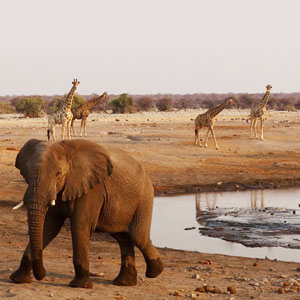
It’s hard to appreciate Namibia’s size – but cycling certainly helps you take in its vast landscapes.
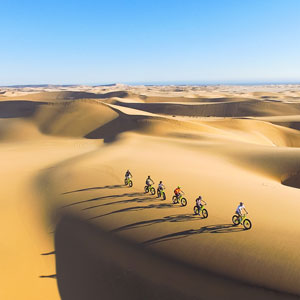
Cycling here seems adventurous – but don’t be daunted. We’ve spoken to the specialists to give you the best tips and advice.