Yunnan walking vacations

Leave the crowds – and the ground – behind on high-altitude, dramatic walks in Yunnan.

One of the most photographed signs in Yunnan? Surely the ‘no swimming’ sign at Tiger Leaping Gorge. You’ll find it affixed to the railing in front of the brown and tumultuous water of the Yangtze River, at the point where it’s forced through a 25m wide gap. A dip in these roiling waters would be a seriously rough ride. Only one person has ever successfully made it down on a raft.

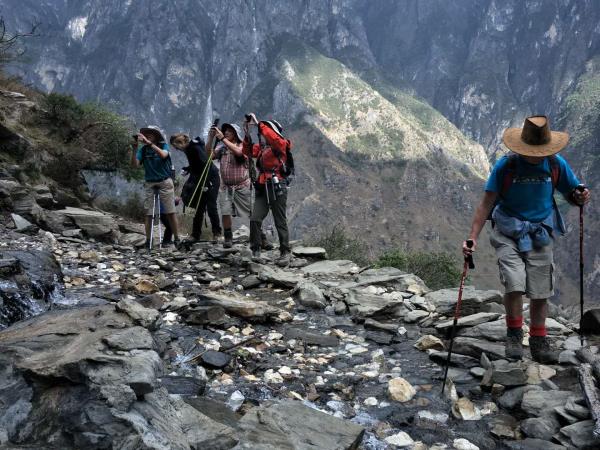
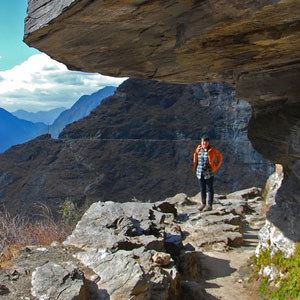
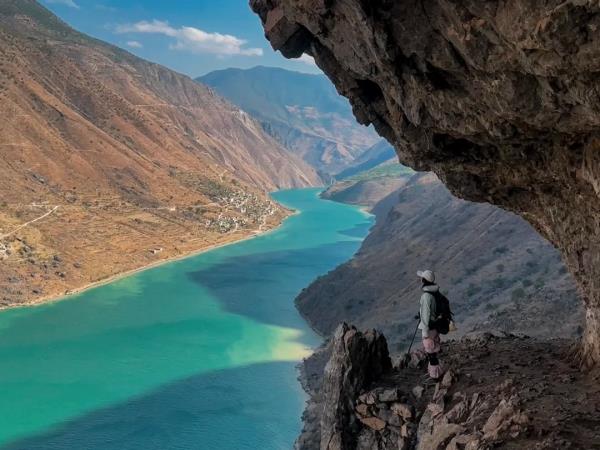
Definitely no swimming then, but plenty of walking. The Tiger Leaping Gorge trek is an easy hike on our Yunnan walking vacations that you can spread over two days to better enjoy the scenery of one of the world’s deepest gorges. The path clings to the mountainside 1,000m above the river, ascending around 28 hairpin bends through the upper section of the gorge, before entering the middle and lower sections. Rather than ‘leaping’ to the finish line, stay at a guest house in the middle to break up the day.

Tiger Leaping Gorge is one of Yunnan’s star attractions, and many domestic tourists visit by car or bus. But whilst the sign gets hundreds of tourists a day, the walk doesn’t.

“The whole trek wasn’t busy, but it was ‘nice’ busy: you saw people and donkeys and cats and goats but it was not really crowded at all,” says Maria Belfort, travel expert from our partner Rickshaw Travel, of her recent visit. “There were loads of little mountain shops, there was an old lady selling ice and fruit. It feels like a genuine hike. A lot of places in China you don’t get that – lots of places are Instagrammable, with queues, but this was not the case at all.”
I’m not exaggerating when I say it was my favorite place that I’ve been to and I want to go back next year. The landscape is incredible.

Yunnan’s quieter side

Yunnan is known for spectacular walking, and it’s by hiking a bit off the beaten track that you can dodge the crowds.

"I’m not exaggerating when I say it was my favorite place that I’ve been to and I want to go back next year,” says Maria. “The landscape is incredible.” Yunnan, China’s south-westernmost province, is a domestic tourism hotspot because of its famed beauty – the city of Lijiang, with its beautiful traditional streets – is a popular site, whilst tickets for the cable car up Jade Dragon Snow Mountain just outside the city, often sell out overnight.

Other areas are devoid of people because they are off-limits. Snow mountains are considered sacred life-giving holy sites in Tibetan Buddhism, and are not climbed – Meili Snow Mountains (highest peak Kawagebo, 6,740m) on the border with Tibet is the most spiritually significant and it’s thought that seeing a golden sunrise at Meili – where the side of the mountain flushes rose gold in the morning light – brings good luck to those early-risers.

On our walking vacations in Yunnan swap the area’s most photographed sign for a view that few see. Upper and Lower Yubeng, sister villages in a valley below Meili Snow Mountain – are only accessible by foot, horse, or off-road vehicle, whilst trekking on the north face of the mountain offers even quieter trails.

What are Yunnan walking vacations like?

Within a single day’s trek, you can move from subtropical river valleys to alpine meadows to glacial landscapes above 4,000m.
“I'll say this without hesitation: Yunnan is, quite simply, the most rewarding trekking destination I have ever experienced,” says Anderson Su, founder and CEO of our partner Mystic Yunnan. They have years of walking experience all over the province, from its borders with Myanmar to Tibet, including a stint conducting a botanical survey in Yunnan’s tropical rainforests.

What do they think sets Yunnan apart? “Verticality,” says Anderson. “Within a single day’s trek, you can move from subtropical river valleys to alpine meadows to glacial landscapes above 4,000m.”

When you head to the north of the province, expect big faces: there are some seriously high mountains, and photographs don’t really give you a sense of their scale. Since your paths intersect with pilgrimage routes you’ll get used to seeing prayer flags strung from rocks, forests of red incense sticks stuck in the earth, and branches of fragrant juniper burnt to create an incense haze. Yaks graze in the alpine pastures, you might spot local people out harvesting the province’s amazingly diverse mushrooms and your guides might mix yak butter and tsampa – roasted barley flour – to make food for the trail.

Khampa horsemen & expert guides

Whilst walkers will get away from the crowds, you’ll want to keep certain people by your side. Like mountain guides who carry oxygen, know the routes, and know when trails are at their quietest. Guides aren’t just useful for showing the way, but acting as translators, souvenir authenticators, menu decoders and more.

On some routes you’ll also be accompanied by Khampa horsemen who’ll help transport hiking and camping equipment. “By employing the horsemen directly at fair wages, we ensure tourism revenue stays within the communities,” explains Anderson. It’s also fitting, given the area’s historic Tea Horse Road – trade routes that started up 2,000 years ago, through which bricks of Yunnan-grown tea and other goods were traded for the surefooted ponies of Tibetan neighbours.

Cultural climbs with diverse villages

As you head southwest in China the population thins and becomes more diverse – some 28 ethnic groups live in Yunnan, including Tibetan and Naxi, descendants of nomads, and this diversity means that culture changes from village to village – making walking between villages very rewarding. “The people you meet are so genuine, warm, kind, funny and fun,” says Maria. “Everyone would talk to us and bring us into their dance groups, kids would run to you and say hello. It didn’t feel like a spectacle. It didn’t feel like they were putting on a show for you. Our curiosity – and theirs – was genuine.”

Misty mountains & heaven villages

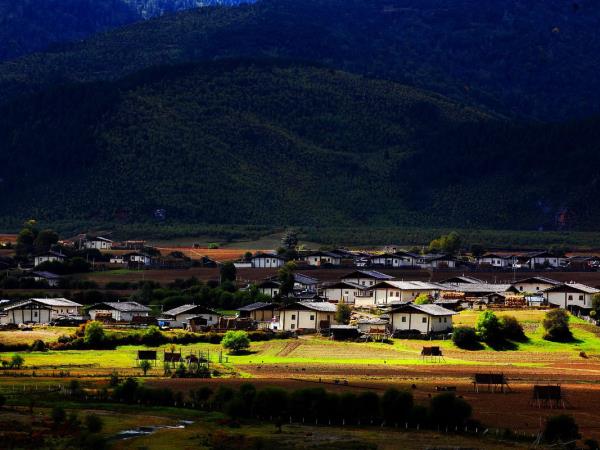
Culture changes village to village; the scenery (and weather) changes too. This is a province with layers and each lifting of the mist reveals a new view: you’ll start to see the inspiration behind traditional Chinese watercolour prints at every viewpoint. Some tour guides have been known to photoshop a view back into the picture to keep their clients happy when there’s mist in the way. You don’t need this. “The weather adds to the experience in a way,” says Maria. “If it’s misty it’s nice.” The mist around Meili mountains has given the villages it shrouds the nickname ‘heaven villages’.

Contact Us

Responsible Travel, Travel Team

Call us for a chat about our vacations. We are happy to discuss your vacation and help in any way we can. No bots, queues or awful hold music.

Responsible Travel, Travel Team

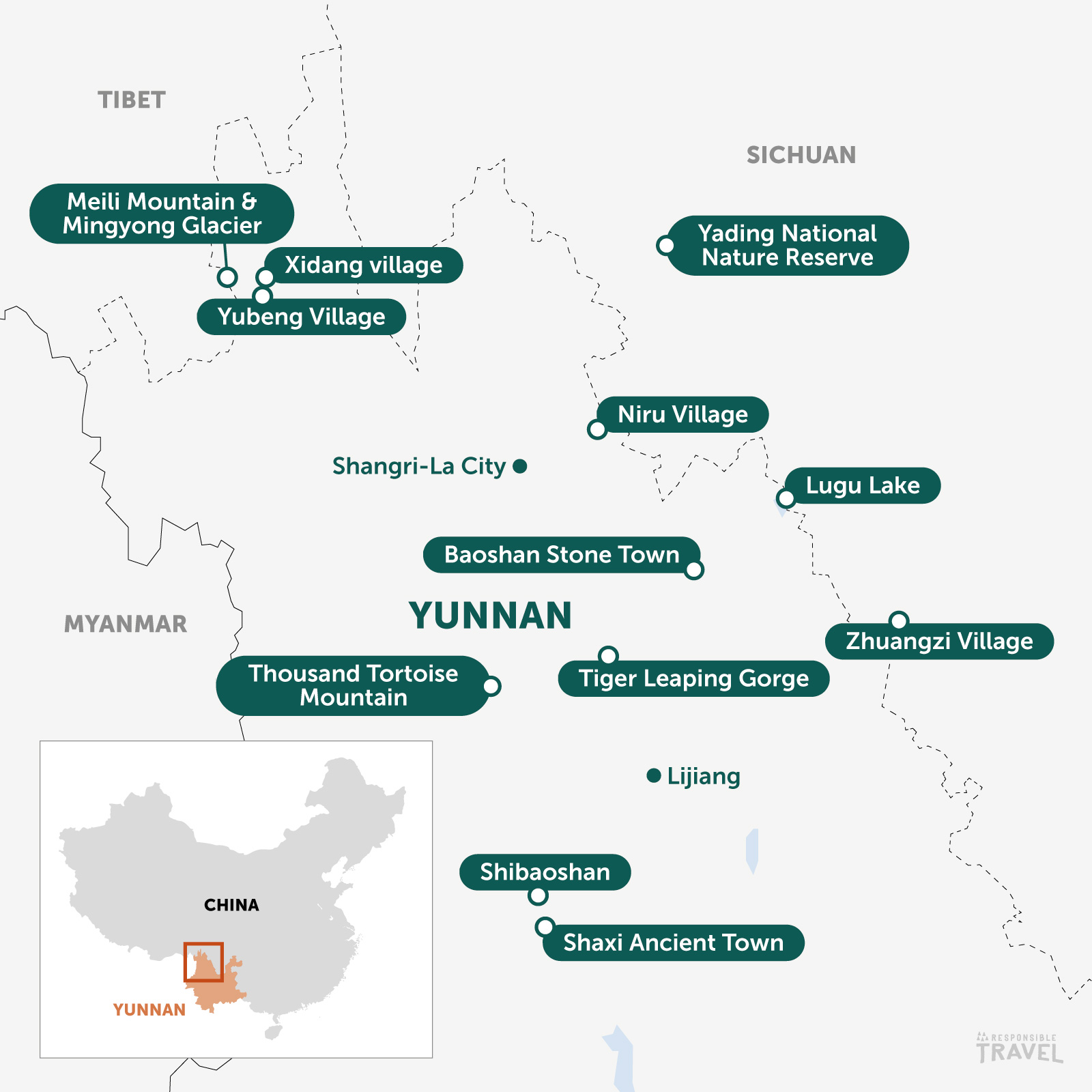
Yunnan walking map

Yunnan walking map

Where to go on Yunnan walking vacations

Tiger Leaping Gorge

“We did the two-day trek, which is the main hike in the region,” says Maria. “I loved it. It was the highlight of the trip for most of us – it was brilliant.” The walk features on many of our itineraries and the most popular way to do it is over two days, with a longer first day, a stay at a guest house in the mountains half-way along, and a short second day. The first day is hardest: “It’s somewhat steep – but mostly steps and it’s really well signposted.” But your reward is a mountain lodge with spectacular views.

Xidang village to Yubeng Villages

Yubeng, under the Meili Mountain, is a great trekking base, which until recently you could only reach by mule or on foot via an 18km trail – though now you can also go by 4x4. Climb up from Xidang Village to the Nanzheng Mountain Pass (3,700m) and then down to reach Upper and Lower Yubeng Villages. Once you’ve reached the high pass, the beautiful views into the valley will draw you down.

Yubeng Village treks

Once you’re in the Yubeng villages, spend the night and wake up the next day to walk from Upper Yubeng village to the base camp (3,700m) for Kawakarpo Peak and see the Glacier Lake, or walk from Lower Yubeng village the steep route up the river to Yubeng’s sacred waterfall at 3,400m. From Lower Yubeng, you can walk down the Yubeng Valley, following the Yubeng River downhill all the way to Ninong Village.

Meili north slope glacier trek

The north slope of the Meili Mountains is less visited than the trails leading from Yubeng. It’s here you can come face to face with the Mingyong and Sinong glaciers. Your route on our north slope glacier trek departs from Yagong Village and goes into the Mekong River Valley. You’ll ascend to Ciding Pass (5,200m) and go to your camp for the night, Pojun Camp, with its amazing views of the face of the mountain. From here you can enjoy day treks to explore the glacier’s edge – from here it’s possible to reach the pass at the Yunnan-Tibet Border, or descend down to Yagong Village again.

Yugu Lake to Baoshan stone town

This is a sociable multi-day trek where you’ll meet people from different ethnic groups while staying in their villages, from Pumi families in Zhuangzi to Naxi people in Liuqing. Start in Yongning Town before trekking through the forest to Zhuangzi Village via the Zhuangzi Pass (3,620 m). Next, drive to Fenglian Village to trek along the Yangtze River Valley to Liuqing. Leave the horses behind before going over the steep Taizi Pass, going via two unlit tunnels to reach Baoshan Stone Town, a 13th-century Naxi village built atop a rock.

Niru Village treks

A dirt road leads to Niru Village close to the Sichuan border, where a Tibetan population lives surrounded by mountain pastures. Stay in a Tibetan guest house in the village, and from here trek to Seven Colour Waterfall, or trek up to Nanbao pastures to spend a night camping in the summer grazing lands at the side of the Black and Yellow Lakes, before returning to Niru via Dingru Lake. Activities back in Niru on our eight day trekking tour might include a cultural evening with village elders.

Stone Treasure Mountain to Shaxi Ancient Town

Unusual rock formations in the red rock give this cypress-covered mountain its name: Shibao Shan, or Stone Treasure Mountain. There are temples and pavilions dotted among the trees – as well as grottoes in the rocks – all linked by walking trails. Afterwards, you can walk on down the valley to Shaxi Village, one of the last preserved spots on the once crucial Tea Horse Road.

Liming

Take your shoes off and walk on the backs of tortoises: the red sandstone at Liming has weathered into such unusual formations that the mountain is called ‘Thousand Tortoises Mountain’ because it looks like it’s comprised of irregular tortoise shells. Try a period of barefoot hiking, so you can feel the soft, warm rock underfoot as you go. As you walk under weird and wonderful rock formations, you won’t be surprised to learn that this is also a great place to go climbing – and you can arrange an optional climb if you fancy on our Yunnan trekking vacation.

Yading Nature Reserve

Yading Nature Reserve is considered one of the most beautiful areas of Sichuan, the neighbouring province to Yunnan. Come from Shangri-La for a day hike at altitude under the three sacred mountains of the park. Whilst pilgrims come to perform kora (holy hikes) clockwise around Chenresig, the highest peak, you can come to see Milk Lake and Five-Colour Lake. You’ll need to acclimatise properly before you go on, a step built in to our Yading holy trek vacation; the lakes stand at 4,600m and 4,700m above sea level respectively.

Tips for walking vacations in Yunnan

The city of Shangri-La (formerly Zhongdian) is at 3,200m and passes on the treks reach elevations of over 5,000m, so acclimatisation is important. Don’t try to go high at the start of the vacation – build up to bigger altitudes as you go. A tour guide can help you prepare sensible elevation gains for each day, and some of our tours have guides carrying oxygen, just in case. Trails like Tiger Leaping Gorge can be very narrow and slippery at times, and can be very steep, so you do have to be extra vigilant with each step, especially in wet weather, and have a head for heights. Steep mountains mean steep climbs to go over the passes between valleys – and lots of steps – so for multi day treks you will need to be a fit and experienced hiker. Yunnan is famous for its wild mushroom season – which runs from June to September, and many of our itineraries include mushroom hotpot so you can try these delicate delicacies – it’s safer to try them in this way than to purchase your own from markets. Also look out for: yak burgers, yak stew, yak butter and yak butter tea. Stay local where you can, especially as mass tourism moves west into Yunnan. “Every booking with a Khampa horseman or a Naxi guest house family is a small but meaningful counter-current,” says Anderson. Finally: no swimming in the Yangtze.
Written by Eloise Barker
Photo credits: [Page banner: James Wheeler] [Yunnan’s quieter side: CEphoto, Uwe Aranas] [Misty mountains & heaven villages: christiali] [Tiger Leaping Gorge: CEphoto, Uwe Aranas] [Yugu Lake to Baoshan stone town: Rod Waddington]