Visiting Chichen Itza, Mexico

Founded around 600-750AD, Chichen Itza in Mexico was one of the most prominent cities of the Maya civilisation that spanned much of Central America and whose descendants today number around six million people. Unlike many other Maya sites that were gradually overtaken by jungle, Chichen Itza never disappeared from the public consciousness, but it was not until the 19th century that its significance was fully understood. Dominated by a step pyramid, this is one of the best-preserved Maya cities in the Americas. An observatory, and many temples and other structures used for rituals demonstrate the breadth and depth of the Mayas’ knowledge in subjects such as astronomy, architecture and medicine.

The name Chichen Itza means ‘at the mouth of the well of the Itza’ and the location was likely chosen because of the amount of cenotes (limestone sinkholes) in the area. One of these cenotes is known as the ‘Well of Sacrifice’ – the Maya practised human sacrifice to appease their gods, but results weren’t guaranteed. By the 16th century, and the arrival of the Spanish conquistadores, the city had been abandoned.

On our Chichen Itza tours, which form part of vacations in the Yucatan region, you’ll have local guides leading you around. This is the best way to really understand these structures’ functions, and their role in Maya society. “Our guides are excellent,” says Kenneth Johnson, founder of our partner EcoColors Tours. “For example if they’re talking about Chichen Itza and they see a motmot bird in the sky, they can immediately switch to telling you about the bird’s historical association with the Maya and how they used the birds’ feathers – they can make those connections and give you a more rounded talk. It’s not just reeling off facts.”

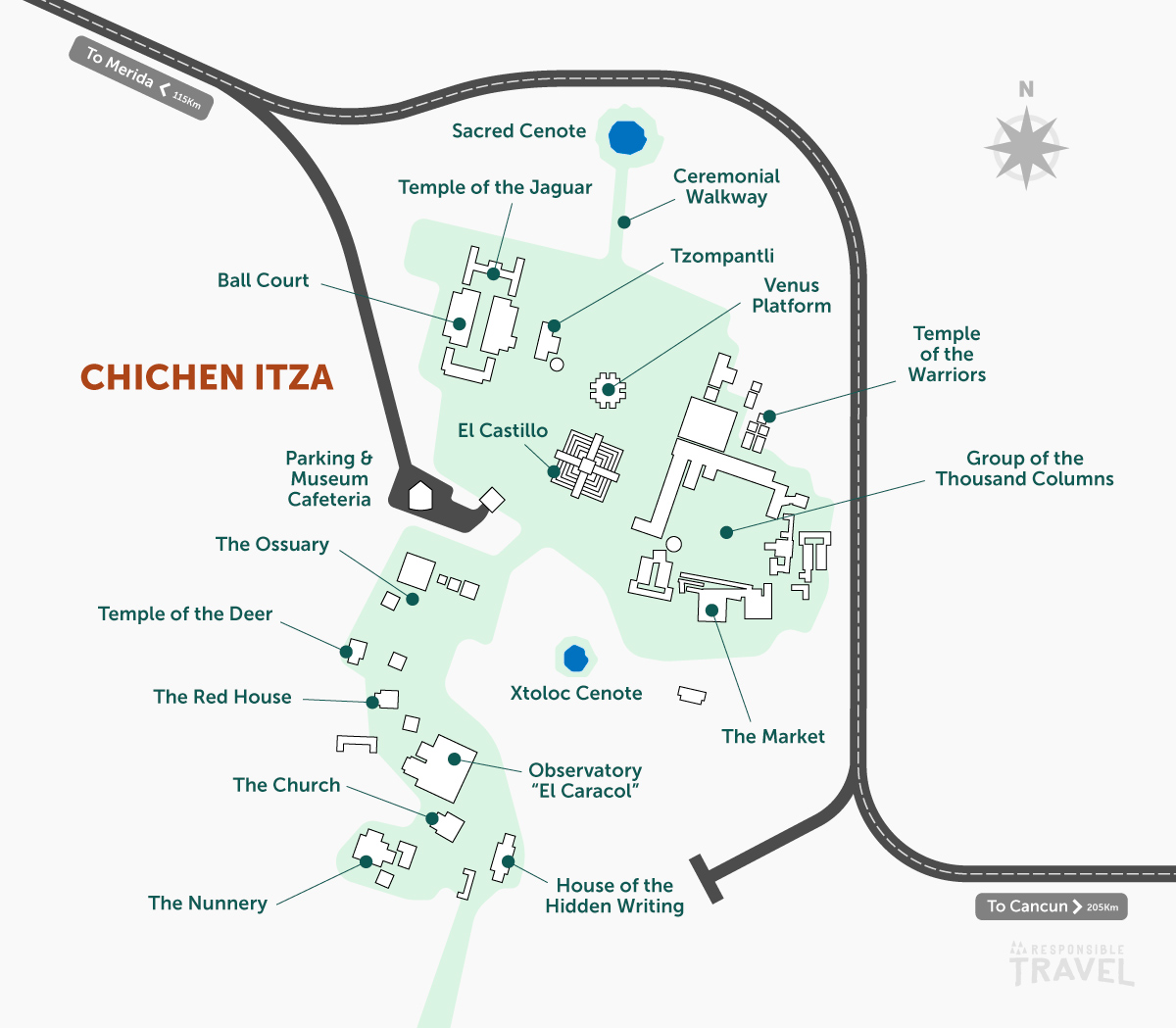
Chichen Itza map

Chichen Itza map: showing the layout of the site

Key sites in Chichen Itza

Chichen Itza’s most significant structures are clustered into three distinct architectural groupings over an area around 5km2, connected by paved causeways. These buildings would once have been very colourful, painted in bold colours, but the pigments have long faded. While the site merits a full day to explore, you can see most of it in three hours or so.

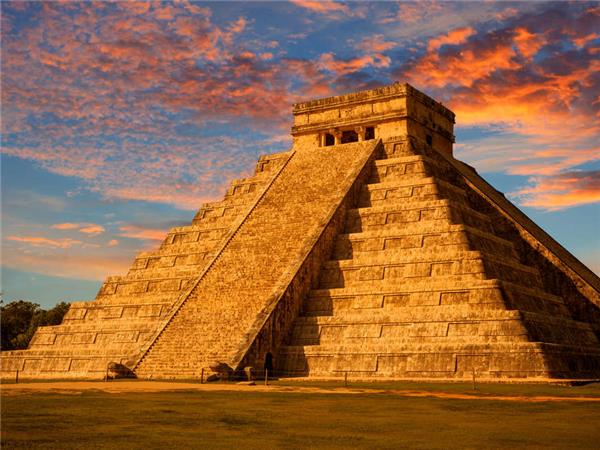
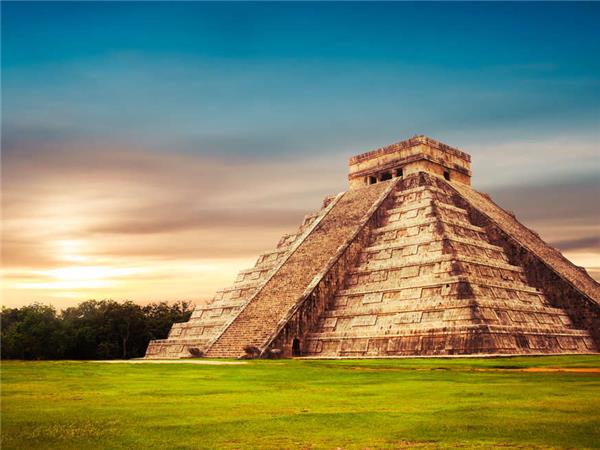
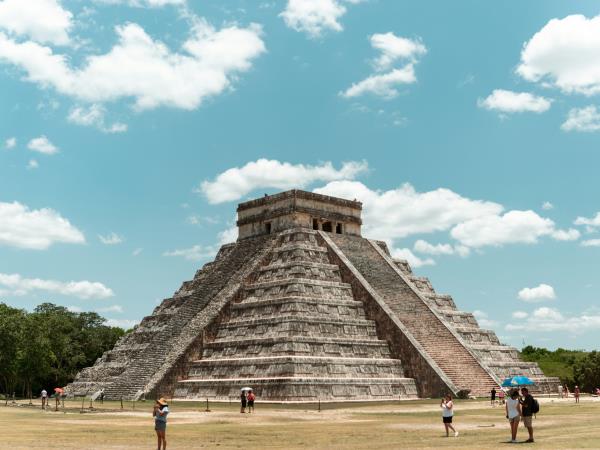
El Castillo – Kukulkan Pyramid

The most recognisable landmark in Chichen Itza is this step-pyramid which gives a fascinating demonstration of the Maya’s people’s astronomical awareness. At the foot of the pyramid there is a stone carving of a snake’s head, and during the spring and autumnal equinoxes, the setting sun casts a shadow onto the pyramid’s stairway that resembles the snake’s body writhing down the steps.

Great Ball Court

You may think your local team’s derby is important, but the Maya’s ball games, known as pitz, had some serious stakes. The games, which could go on for two weeks, were played to resolve disputes instead of going to war, and it’s thought that losing players would sometimes be decapitated as a form of ritual sacrifice to the gods. Hard to imagine that doing much for team spirit. The Great Ball Court at Chichen Itza is the largest of these playing fields found to date.

Well of Sacrifice

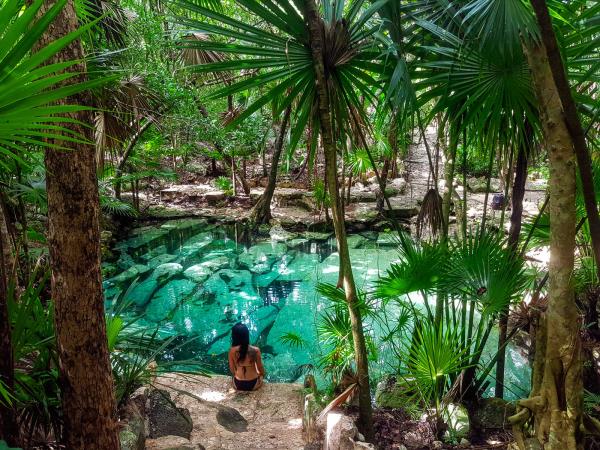
Cenotes are found throughout Mexico and you can often enjoy a swim in them. The Maya however saw them as doors to the underworld. There are four known cenotes in Chichen Itza and one of them was known as the Well of Sacrifice. Many artefacts made of gold, jade, shell and other materials have been found inside, and the theory is that these were offerings to the gods. Human skeletons have also been discovered, indicating that the cenote was also used for human sacrifice.

El Caracol

The Mayas had a fascination with astronomy, and markings in this observatory indicate that they were predicting and recording solar eclipses. El Caracol (the snail, so-named for its spiral staircase), offered unobstructed views of the night skies above the Yucatan, allowing the Maya to track the progress of Venus, among other celestial bodies.

Other points of interest around Chichen Itza include the Temple of the Warriors and the adjacent Thousand Columns, thought to have once supported a roof over a vast meeting space; the Nunnery, the Jaguar Temple, and the Skull Platform.

On our tailor made Yucatan tours you can stay around into the evening for the Chichen Itza Light and Sound show, when the ruins are colourfully illuminated. “It’s very nice, very artistic,” says Kenneth. “The show tells the story of the Maya and Chichen Itza mixed with myth and legend, so it does require some interpretation from the guides. You’re sat on chairs looking at projections on three different structures, so it’s like a theatrical show.”

Another option, if you’re on of our Yucatan trips and not rushing back to Cancun, is to stay a bit longer and share a meal with a local family. As well as ensuring the surrounding community benefits from tourism, this experience helps you understand more about modern Maya lifestyles. Pibil is a traditional Maya style of cooking that sees meat being barbecued underground, and the technique has been passed down through generations, with every member of the family (and their guests) helping to prepare the marinade, the tortillas and the fire pit.

Contact Us

Responsible Travel, Travel Team

Call us for a chat about our vacations. We are happy to discuss your vacation and help in any way we can. No bots, queues or awful hold music.

Responsible Travel, Travel Team

Alternatives to Chichen Itza

Chichen Itza does get busy, but there are many other notable archaeological sites around Yucatan that see far fewer visitors. They can either serve as an alternative to Chichen Itza, or complement it. “There are 2,000-3000 archaeological sites in Yucatan and most are still covered by jungle,” says Kenneth. “One place we go is El Naranjal. Much of it is still buried under trees. No reconstruction work has been done at all, a Maya community lives there.”

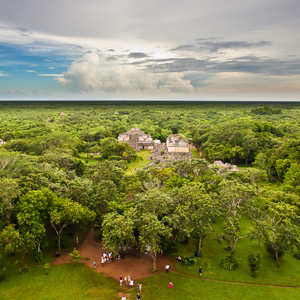
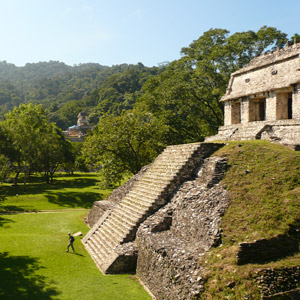
Ek Balam is shrouded in jungle, but was once a powerful kingdom. There is a ball court here, an acropolis, and also a sweat bath. Similar to modern saunas, these were used by the Maya for healing ailments as well as cleaning themselves. Palenque is smaller than Chichen Itza but notable for its superbly preserved architecture, to the point that archaeologists have been able to learn a great deal about its culture from studying hieroglyphics on the walls.

Entrance fees for these ancient Maya sites go towards the vital work of maintaining them. And as well as sourcing guides from local communities, our wider Yucatan trips support modern Maya communities in many ways, from funding solar panels and water pumps to hiring fishermen as boat pilots. “We knew of a small Maya village, 60 people or so, living in the jungle with no education, no schools,” says Kenneth. “One of our guests felt inspired to make a direct donation to a local project, and we facilitated that. It allowed these people to raise their production from 10 litres a year to 1,500 litres, so this is one example of our vacations have been able to make a huge difference.”

What does visiting Chichen Itza involve?

What’s so special about Chichen Itza?

Among all the Maya sites in Central America, Chichen Itza is among the most renowned. “It’s the size of the place, and the number of restored structures,” says Kenneth, “this is one of the main Maya cities. Then there is the fact it’s not far from Cancun, and there have been some amazing research findings such as the huge ball court.”

As Chichen Itza is so well preserved, it has told researchers a great deal about Maya architecture, culture and beliefs. The equinox snake on El Castillo also demonstrates the Maya people’s fascination with, and knowledge of, astronomy and mathematics. There are a great many mysteries still to be uncovered, perhaps the greatest of all being why people kept signing up for the ballgames.

Where is Chichen Itza?

Chichen Itza is in the Yucatan Peninsula, in eastern Mexico. As the site is 125km west of Cancun, you get a lot of coaches bringing day trippers, but most don’t arrive until mid-morning, so if you arrive early enough, as our vacations aim to, it can be nice and quiet. The site is also accessible from Tulum (150km southeast), Merida (120km west) and Playa del Carmen (180km east).

Can you climb Chichen Itza?

No one is allowed to climb El Castillo, the Temple of Kukulcan. The aim is to protect the structural integrity of the 30m-high pyramid, but a secondary reason is that people do tend to fall off sometimes, which is not ideal. Professional photographic equipment including tripods and drones is also banned.

When to visit

There isn’t a great deal of shade around Chichen Itza, so while the site is open to visitors year-round, November to March tends to be the best time to come, when the weather is cooler. These also tend to be the quietest months, and means that guides benefit from more out-of-season income.
Written by Rob Perkins
Photo credits: [Page banner: Pascal] [Intro: Luis Aceves] [Great Ball Court: Brian Snelson] [Ek Balam: Sharon Hahn Darlin] [What’s so special about Chichen Itza?: Bmamlin]